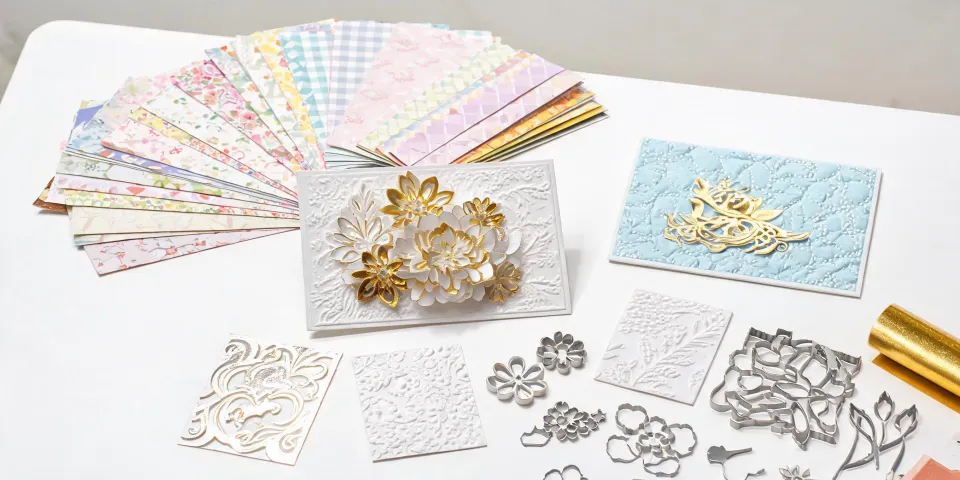
Start with production reality, not the machine
I'm the person who reviews dies, die-cut samples, greeting card blanks, and holiday figurines before they reach customers. Over the last four years, I've checked roughly 200 unique items a year. One lesson I've learned as a quality inspector is that there's no single "best" die cutting machine. There's only the machine that matches the way you actually produce.
Here's something vendors won't tell you: cut quality isn't a feature of one product. It's the result of a system—the die, the cutting machine, the paper, the storage, and the operator. Change one link in that chain and the output changes. A die that gives clean cuts in one shop can tear or miss in another because the machine delivers a different pressure.
So I never start a buying conversation with "which machine is the best?" I start with which production scenario you're in. In my audits, craft businesses usually fall into one of three groups:
- Boutique and workshop producers making 25–100 pieces per design, with designs changing constantly.
- Card and stationery studios making cards in volume, where standard envelope fit is part of the product.
- Seasonal and holiday production teams running a single holiday figurine or ornament design in quantities of 1,000 or more.
Those groups need three different quality standards. Let's go through each.
Profile 1: The boutique and workshop
If you're in profile 1, your biggest risk isn't machine durability. It's repeatability between sessions. When you change dies constantly, someone on the team will eventually adjust the platform differently, stack paper differently, or put a plate in the wrong way. The result is a card set that looks like it was made by two different workshops.
For this profile, I'd rather see you buy a cohesive system than save money piece by piece. A die from an unfamiliar line might look fine under a ruler but not sit properly on your machine platform, and that gap will show up in every cut. Die and platform geometry are a quality issue, not just a compatibility issue.
The Spellbinders Platinum machine is one I often put on the shortlist for small shops. It's not the largest or most complex unit, but it's stable, and it handles the 6-inch die sizes that most boutique Christmas and card projects require. There's something satisfying about seeing a full workshop produce the same clean cut with nobody having to troubleshoot the machine.
For seasonal work, choose one coordinated collection rather than assembling from multiple lines. Spellbinders Classic Mouse Christmas is a helpful example. From a QC perspective, the best part isn't only the design—it's that the pieces are made to work together, so you don't get a finished product where every element looks like it came from a different project.
Profile 2: The card and stationery studio
Profile 2 is where dimensions become the main character. You can print beautiful artwork and make a clean fold, but if the finished card is one millimeter too wide, it will jam envelopes in an automated line. In stationery, standard size is not a preference; it's a product specification.
So, let's answer a common search question directly: what is a standard size greeting card? According to the Greeting Card Association's sizing tables (always verify current specs before large production runs; these were the standard North American sizes as of January 2025):
- A2: 4.25 × 5.5 inches. This is the most common folded greeting card size in retail.
- A6: 4.5 × 6.25 inches. Common for photo cards, invitations, and note cards.
- A7: 5 × 7 inches. Standard for larger invitations and flat cards.
Why do I make a big deal about one millimeter? In Q3 2024, we rejected 12,000 pre-cut card blanks because the fold line had drifted by 1.5 mm from one side of the run to the other. The blanks looked fine until we placed them into standard A2 envelopes; every card sat crooked. The supplier said it was within industry tolerance. It wasn't within ours, because our customers expect cards to fit envelopes without a second thought.
If you're running a card studio, pay attention to die storage as much as the machine. When I inspect returned samples, the most common mystery defect is a small burr or bent edge on a die, caused by careless storage. That defect transfers to every future card. The Spellbinders Craft Stax line helps solve this: it's an organized die storage system that keeps edges protected and makes it easy to find the correct die in a hurry.
Craft Stax may not be the glamorous purchase in a card studio, but in a production setting, it's the kind of purchase that prevents defects nobody planned for.
Profile 3: Seasonal and high-volume production
Profile 3 is where most quality problems show up. Holiday figurines are the perfect example. A figurine isn't one single cut; it's often 30 or more pieces that need to align precisely. If each component has a 99% chance of being within spec, the probability that all 30 components are within spec is only about 74% (0.99 to the 30th power). That's the compound defect problem. High-volume craft production cannot succeed with a machine and die that are "pretty good."
People assume the quality of a holiday figurine comes from how complex the die is. It doesn't. The real driver is whether the cutting machine can deliver the same pressure after dozens, hundreds, and thousands of cycles. If pressure drifts slightly, fold lines shift, edges start rounding, and the finished figurine no longer sits flat. The first ten samples won't reveal it. The 700th piece will.
For this production profile, I specify a large-format, mechanically stable system. In our quality testing plans, the Spellbinders Grand Calibur is the machine I use to validate large holiday projects because it gives enough platform area and stable repeat pressure for the heavier materials used in dimensional pieces.
I still kick myself for one holiday figurine launch where we approved materials based on samples cut in a climate-controlled room. The pre-production pieces looked perfect. Three weeks later, in real storage conditions, the folded bases began to curl and 8,000 units had to be re-run. If I could redo that decision, I'd test the system in the actual environment—temperature, humidity, storage—before signing off. And I'd measure pieces after a wait period, not only right after the cut.
Which scenario are you?
Here's the practical way to decide, with three questions I ask before recommending anything:
- What is your largest batch of one design? Under 100 pieces? You're probably Profile 1. More than 1,000 identical 3D pieces? You're Profile 3.
- Do your products need to fit standard envelopes? If yes, Profile 2 dimensional standards apply even if you only make 50 at a time.
- Is your most common defect always the same? If it's the same issue—pressure marks, drifting fold lines, uneven edges—it's a machine and process problem, so choose Profile 3's approach and invest in stability.
If you're mixed, assume you're the highest-demand profile among the three. That will keep you safe.
One final thought from a quality inspector's desk: I trust a supplier that tells me where their product isn't the right answer more than one that claims everything is universal. We don't claim one Spellbinders machine is right for every craft business. We'd rather help you match a system to your actual output, your envelope sizes, and your seasonal volumes. That's the most honest quality check of all.