The 36-hour panic call that changed how I plan holiday gifts
In November 2024, a client called at 7:40 a.m. needing 300 personalized greeting cards and 300 Christmas ornaments for a donor event 36 hours later. Normal turnaround was 10 business days. We had done rush orders before, but this one exposed the real problem: not design, not shipping, but spec drift.
I work in rush production for a gift and craft fulfillment company. In the last 18 months, I have handled 60+ rush orders, including same-day turnarounds for retail launch clients. My job is triage: how many hours are left, what is actually feasible, what is the worst-case outcome. The 36-hour call was feasible only because the client accepted a simplified personalization tier. Not ideal, but workable.
When I first started managing holiday gift production, I assumed late orders were a design problem. Three missed mail dates later, I realized it was a specification problem. The design was rarely the bottleneck. The gap between what the buyer meant by 'personalized' and what the production floor could execute was the bottleneck.
The surface problem: everyone thinks personalization is a design task
B2B gift buyers usually come from marketing, HR, or procurement. They are good at brand and deadlines. They are not always fluent in paper weights, die cut tolerances, envelope sizes, or postal rules. So they brief a project as: 'We need 500 personalized greeting cards and a Christmas ornament for each client.'
That sounds clear. It is not. What does personalized mean? A first name? A company logo? A handwritten note? A unique QR code? A digital gift card code printed inside? Each choice changes the production method. A printed name is one thing. A die-cut monogram in metallic cardstock is another. A small Christmas ornament with a name and date requires a different assembly line.
This is where the first hidden cost appears. A greeting card that fits USPS letter dimensions can mail for $0.73 per ounce as of January 2025. A slightly thicker card, or one with a small ornament, can push the mail piece into large envelope or parcel pricing. According to USPS (usps.com), First-Class Mail letters must be between 3.5 by 5 inches and 6.125 by 11.5 inches, with a maximum thickness of 0.25 inches. Large envelopes start at $1.50 for the first ounce. That is more than double the letter rate. On 500 pieces, that is a $385 difference before you count additional ounces. Surprise, surprise.
The deeper cause: your holiday gift program has three invisible bottlenecks
1. Spec drift between 'personalized' and 'producible'
Personalization is a spectrum, not a switch. At one end, you have a generic greeting card with a printed logo. At the other, you have a handmade Christmas ornament with a name, date, and custom color palette. Most B2B buyers ask for the second but budget for the first.
In my first year, I made the classic specification error: I assumed 'standard' meant the same thing to every vendor and every client. Cost me a $600 redo on 400 cards because the approved cardstock was too thick for the envelopes the client had already ordered. The cards looked great. They just did not fit. A lesson learned the hard way.
The fix is not more design meetings. It is a one-page spec sheet that locks: final trim size, paper weight, envelope size, personalization method, variable data source, and mailing class. If the spec sheet is not signed, the project is not ready for production.
2. Die cutting is not printing
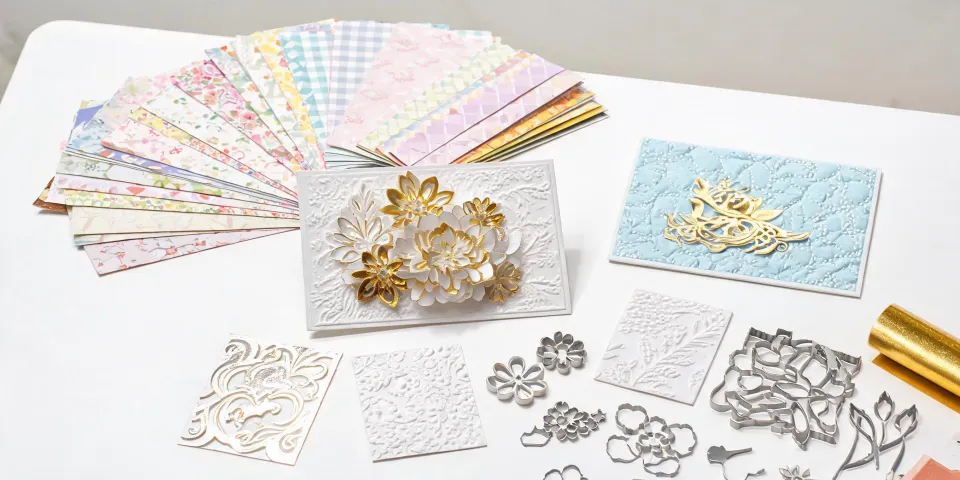
This is the part that trips up teams who are used to digital print workflows. With printing, you send a file and get output. With die cutting, you need a machine, a die, a sandwich of plates, paper, and sometimes shims. The Spellbinders Platinum die cutting machine is a workhorse for this kind of production because it gives consistent pressure and works with the Spellbinders crafts ecosystem of dies and kits. But it still requires testing.
You cannot assume a die will cut perfectly through every cardstock on the first pass. Metallic paper, glitter paper, and thick chipboard behave differently. If you are producing a Christmas ornament, the die may need a different plate combination than a greeting card. If you are producing both, you need separate test cuts and separate quality checks.
In a rush, this is where hours disappear. The design is approved. The paper is in-house. The machine is ready. But the die is not cutting cleanly, so someone is adding a shim and running 20 test pieces. That is not a design problem. That is a process problem.
3. The digital and physical fulfillment split
Many corporate gift programs now combine a physical greeting card or Christmas ornament with a digital gift card. The physical piece is personal and memorable. The digital gift card is instant and easy to deliver. But combining them creates a synchronization problem.
If the digital gift card code must be printed inside the greeting card, the code generation has to happen before the card is assembled. If the digital gift card is sent by email, the physical piece needs a matching identifier so the recipient knows which gift belongs to which code. If the physical piece is delayed, the digital gift card may arrive first and confuse the recipient. If the digital gift card is delayed, the physical card arrives without the actual gift.
This is why the question 'where to create personalized digital gift cards?' is not just a platform question. For B2B programs, the real question is where to create personalized digital gift cards at scale with unique codes, bulk upload, scheduled delivery, and brand controls. A consumer-facing gift card creator may work for one person. It rarely works for 500 clients, each with a different name, code, and delivery date.
According to FTC advertising guidelines (ftc.gov), if you advertise a gift as personalized or handmade, the claim must be truthful and substantiated. That means if the digital gift card is generic but the card is personalized, do not market the whole package as fully personalized. Clear language prevents mismatched expectations later. An informed customer asks better questions and makes faster decisions.
The cost of getting this wrong
When these three bottlenecks line up, the cost is not just rush fees. It is a chain reaction.
- Rush production fees: often 25% to 50% above standard production cost.
- Reprints: if the die cut is wrong or the variable data is mismatched, you may need to redo the entire run.
- Postage reclassification: a greeting card that becomes a large envelope or parcel can add hundreds or thousands of dollars in mailing costs.
- Missed event dates: for donor events, retail launches, or employee recognition programs, a late gift is often worse than no gift.
- Brand damage: a personalized gift with the wrong name or a broken digital code is memorable for the wrong reason.
Our company lost a $14,000 contract in 2023 because we tried to save $700 on standard die cutting instead of building in a 48-hour buffer. The client's event happened without our gift. That is when we implemented our 'no signed spec, no production' policy.
The fix: a holiday personalization runbook
The solution is not more effort. It is more sequencing. After the 36-hour call, we built a simple runbook for B2B holiday gift programs. It has five steps.
- Define personalization tiers. Tier 1: printed logo. Tier 2: printed name plus logo. Tier 3: die-cut monogram or custom Christmas ornament. Tier 4: physical piece plus personalized digital gift card. Each tier has a different lead time and cost range. Choose the tier before design starts.
- Lock the spec sheet. Include trim size, paper weight, envelope dimensions, die template, variable data format, and mailing class. Verify against USPS current rates and dimensions. Prices change; verify before you quote.
- Test the die cut early. Run the exact paper, die, and machine combination before the full run. With a Spellbinders Platinum die cutting machine, keep a log of plate combinations that work for each material. This saves hours during peak season.
- Separate physical and digital fulfillment. If you use digital gift cards, choose a platform that supports bulk code generation, unique recipient data, scheduled delivery, and brand customization. For B2B scale, that is where to create personalized digital gift cards without manual copy-paste. Then build a reconciliation step: every digital code must map to a physical card or ornament ID.
- Build a 48-hour buffer. Not because things always go wrong, but because they usually go wrong in small ways. A 48-hour buffer turns a crisis into a correction. It is cheaper than rush fees and much cheaper than a missed event.
The bottom line
Personalized holiday greeting cards and Christmas ornaments are not hard because people lack creativity. They are hard because the work crosses design, die cutting, variable data, mailing regulations, and digital fulfillment. When those pieces are not sequenced, a beautiful idea becomes a rushed, expensive mess.
If you are planning a B2B holiday gift program, start with the spec sheet, not the design. Test the die cut before you commit to 500 pieces. Decide early whether the digital gift card is a bonus or the main gift. And give yourself a buffer. The goal is not to be the cheapest. The goal is to deliver something personal, on time, without a panic call at 7:40 a.m.
Prices as of January 2025; verify current USPS rates and FTC guidance before finalizing your program.