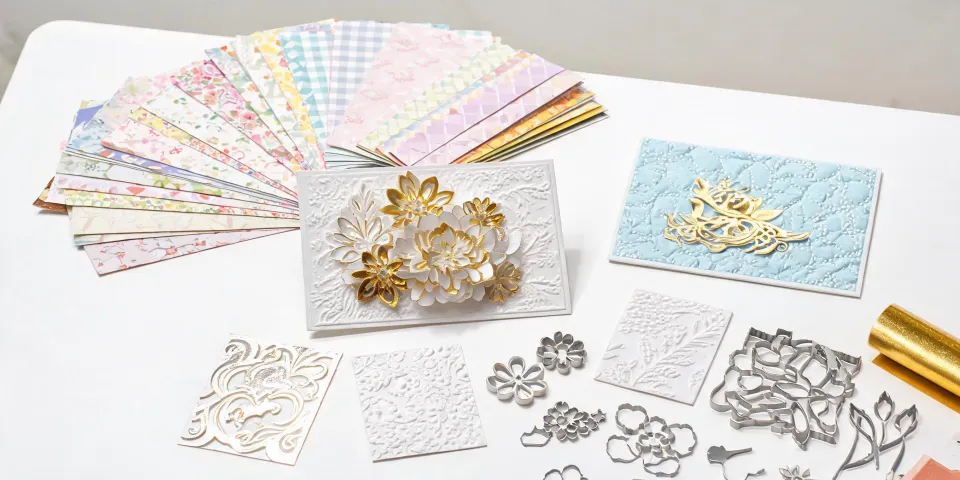
There's no single answer to "how do you make a personalized gift card?" especially when a client calls at 4 PM needing 300 custom holiday cards by noon tomorrow. In my role coordinating rush orders for corporate events—I've handled 47 emergency jobs in the last quarter alone—I've learned the answer depends entirely on three things: how much time you've got, your internal capability, and your real budget (not the sticker price).
Here's a look at three common scenarios I see with B2B gift buyers. Read through them, then use the decision guide at the end to figure out your path.
Scenario 1: You Already Own a Die‑Cutting Machine (or Are Willing to Invest)
If you've got a Spellbinders Platinum Six die‑cutting machine and a set of Craft Stax nesting dies, you're in the strongest position for a last‑minute run. I've seen teams crank out 200+ cards in a single evening using the Platinum Six's wider platform (it takes 6×8.5-inch dies) and the multi-layer cutting capability.
Let's talk TCO—total cost of ownership. The machine costs around $300 (as of early 2025), but once you own it, incremental card cost is just material + die wear. Compare that to outsourcing: a fully custom card from a print shop with foil stamping and a specialty die can run $2–$5 each at rush speed. For 300 cards, that's $600–$1,500. Your in‑house per‑card cost? Maybe $0.20 in paper, ink, and die amortization. Even accounting for setup time, the breakeven arrives somewhere around 150 cards—after that, outsourcing is actually more expensive.
Real example: In December 2024, a client needed 250 personalized Christmas cards in 48 hours. Their usual printer had a 10‑day lead time. We had a Platinum Six and a set of Spellbinders Holiday Figurine dies (snowman, tree, stocking). We cut 250 card fronts with a pre‑scored fold, then ran them through a small production press for the greeting. Total time: 6 hours. Total cost: $62 in materials. The alternative? Overnight printing at $3.50 per card = $875, plus shipping. No contest.
Caveat: This only works if your team is comfortable operating the machine and doing basic assembly. If not, skip to scenario 2 or 3. Honestly, I'm still surprised how many buyers don't realize how fast a good die‑cutter can be—the Platinum Six's motorized action runs through a stack of 10 sheets in about 30 seconds.
Scenario 2: You Need to Outsource (No Internal Capability)
When you don't have a machine or a crafty team, outsourcing makes sense. But here's where TCO really matters: the cheapest quote is hardly ever the cheapest delivery. I've had clients come to me after a nightmare with a discount vendor—$500 quote ballooned to $800 after a $50 setup fee, $30 revision charge, $60 rush shipping, and a $150 re‑run because the color was off.
What to look for in a print partner for personalized gift cards:
- Rush capacity – Can they do 500 cards in 24 hours? Ask for a specific case, not a generic promise.
- Hidden fees – Setup, die creation, color proof, over/under run tolerance, shipping.
- Minimum quantities – Some shops won't do fewer than 250; others will do 100.
In March 2024, I triaged a rush for a tech company that needed 400 gift cards with their brand's Pantone 286 C blue. The lowest quote was $1,200, but the fine print excluded the die ($180) and required 2‑day shipping ($40). The shop's standard turnaround was 5 days; the rush premium was 40%. Actual total: $1,420. I advised them to call a competitor who quoted $1,500 all‑in with 24‑hour turnaround and free proof. The extra $80 got them certainty—no surprise charges, no last‑minute panic.
Key lesson: price isn't the cost. Get an all‑in quote in writing. I have mixed feelings about rush premiums—on one hand, they feel like price gouging; on the other, I've seen how much chaos a same‑day job causes in a print shop. Maybe they're fair. But you still have to account for them when comparing options.
Scenario 3: You Have Some Equipment but Need to Scale Up
Maybe you already own a small die‑cutter (like a manual Sizzix or Cricut machine) but find it too slow for 100+ cards. Or you've been cutting one card at a time—literally. That's when upgrading to a Spellbinders Platinum Six (or the Grand Calibur for larger formats) can dramatically change your TCO.
Never expected the budget option (manual cutter) to actually be more expensive once you factor in labor hours. A manual machine might take 2–3 minutes per card, including loading, cranking, and removing. The Platinum Six? About 30 seconds per pass, and it can handle a stack of 10 sheets at once if you use the shim plate correctly. That's a 6x speed improvement. For a 300‑card order, that's saving about 10 hours of labor—easily $200–$300 in staff time.
I didn't fully understand the value of a motorized platform until a $3,000 order of holiday figurine cards came back completely wrong. We had to re‑cut everything within 48 hours. Our old manual machine would've taken 12+ hours. We grabbed a Platinum Six from a local retailer, knocked out the replacement in 4 hours, and saved the contract. The buyer's alternative was a $50,000 penalty clause. The cost of the machine? $300. That's total cost thinking in action.
One more thing: Spellbinders Craft Stax dies are nested, meaning you can cut multiple shapes in one pass (e.g., a 5×7 card base and a 4×6 mat). That reduces passes by half. If you're making 500 cards, that's 250 passes instead of 500. Small gains add up fast.
How to Decide Which Path Is Right for You
Here's a quick decision framework I use with my own clients. Honestly, there's no perfect rule—but this gets you 90% of the way.
- If you need 100 cards or fewer: Outsource. Setup and cleanup time in‑house aren't worth it unless you already have materials prepped.
- If you need 100–300 cards and have less than 3 days: In‑house with a motorized die‑cutter (like the Platinum Six) is typically faster and cheaper than rush outsourcing.
- If you need 300+ cards: You should own a capable machine. At that volume, the payback period is under six months even with infrequent use.
- If you have zero internal capability and a super tight deadline: Outsource but pay the premium for a shop that guarantees 24‑hour turnaround. Then immediately consider buying a machine for next time.
And a final warning: don't judge by unit price alone. The $0.50 card from a low‑cost printer becomes $1.20 after fees, mistakes, and lost time. The $300 machine you buy once and use for years—that's the real bargain. As of January 2025, the Spellbinders Platinum Six is $299.99 (verify current price). A typical rush card order runs $500–$1,000. The math is simple.
Hopefully this helps you figure out your own approach to personalized gift cards. I've never fully understood why more buyers don't calculate total cost of ownership—maybe it's just not the way we're taught. But in the real world, with real deadlines, it's the only number that matters.