-
1. Is the Spellbinders Platinum really worth it for a business?
-
2. Are Spellbinders dies compatible with other machines?
-
3. What is the Spellbinders City Holiday collection?
-
4. How do I pick Christmas ornaments that don't look cheap?
-
5. Where do businesses buy scrapbooking paper in bulk?
-
6. Do greeting cards need special postage?
-
7. Why did my dies and paper fail in storage?
I'm a quality and brand compliance manager for a craft manufacturer. I review every die set, paper lot, and ornament mold before it reaches our customers—roughly 200 unique items a year. These are the questions buyers actually ask me about Spellbinders, and the answers I give when we're off the record.
- Is the Spellbinders Platinum really worth it for a business?
- Are Spellbinders dies compatible with other machines?
- What is the Spellbinders City Holiday collection?
- How do I pick Christmas ornaments that don't look cheap?
- Where do businesses buy scrapbooking paper in bulk?
- Do greeting cards need special postage?
- Why did my dies and paper fail in storage?
1. Is the Spellbinders Platinum really worth it for a business?
Honestly? It depends on what you're producing. I've reviewed output from the Spellbinders Platinum die cutting machine against our own tolerances for four years now, and the consistency is the reason we specify it for production samples. The pressure stays even across the whole cutting plate—no soft corners, no half-cut edges on the third pass.
That said, I'm not going to tell you it's the right tool for every shop. If you're cutting three cards a week for personal use, a lighter machine will do. But if you're fulfilling a 1,000-unit order and every single die-cut has to match the approved sample, the Platinum saves you from the conversation I hate: "why does this batch look different from the last one?" That conversation cost us a $22,000 redo back in 2023. Now we check spec compliance before we commit.
2. Are Spellbinders dies compatible with other machines?
Most dies are physically compatible with other leading platforms, yes. But here's something vendors won't tell you: compatible doesn't mean identical. I've measured die dimensions and cut depth across brands, and the tolerances vary—sometimes by a lot. A die that cuts perfectly in one machine might leave a slight score line instead of a clean cut in another, especially on thicker materials.
In our Q1 2024 quality audit, we tested a set of Spellbinders dies in three different machines. The results were good in all three, but the cleanest edges were in the Platinum series machine. At least, that's been my experience with our production environment. If you're mixing systems, always run a test sheet before you commit to a large run.
3. What is the Spellbinders City Holiday collection?
City Holiday is Spellbinders' seasonal line of mini die sets, ornaments, and layered greeting cards themed around iconic city skylines and holiday street scenes. It's been one of our fastest-moving holiday ranges since it launched. What impresses me as a quality person is the alignment: the layering pieces line up cleanly, and the holiday figurines have crisp detailing without fragile points that break in transit.
One note: because these are seasonal, designs rotate. The collection I'm referencing was accurate as of Q4 2024. If you're planning a holiday catalog, verify current availability early—our 50,000-unit annual order in 2024 nearly missed the cutoff because we assumed a previous year's set would return. It didn't.
4. How do I pick Christmas ornaments that don't look cheap?
I run a blind test with our procurement team every year around July: same ornament design, two different factories. Without knowing which was which, 78% picked the higher-cost version as "more professional." The difference wasn't the paint color or the shape—it was the seams. Cheap ornaments almost always have visible mold lines, and once they're on a tree, that's what people notice.
When you're evaluating Christmas ornament suppliers, check three things: seam lines, paint coverage on the underside, and package fit. A loose box means the ornament rattles in transit. We rejected a batch of 8,000 units in 2022 because the paint was visibly off—0.5 mm deviation against our spec, which is triple our 0.15 mm tolerance. The vendor called it "within industry standard." We called it a redo. Now every contract includes seam and paint specifications.
5. Where do businesses buy scrapbooking paper in bulk?
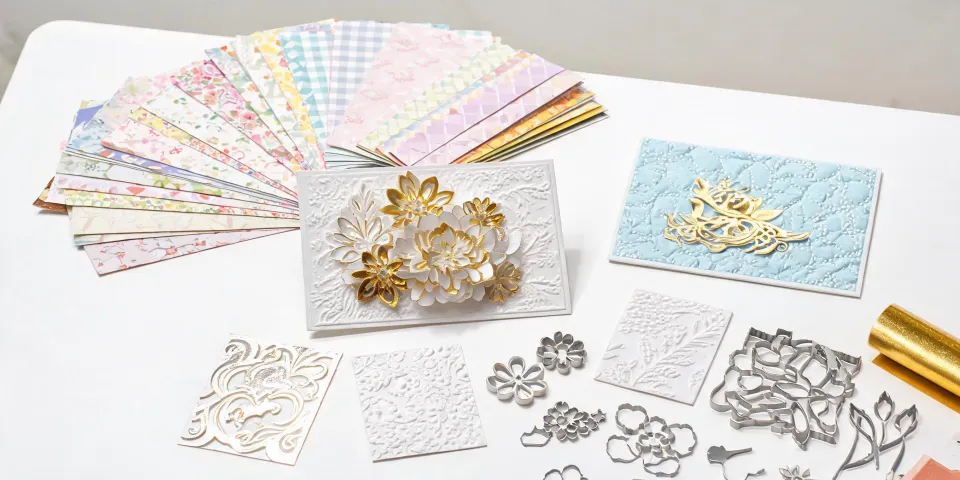
If you're asking where to buy scrapbooking paper as a business, the answer is usually: authorized distributors, not retail craft stores. Retail pricing includes markup that your margins can't absorb. Spellbinders has its own paper collections that coordinate with die sets, which is worth it when you're selling kits because the customer doesn't have to hunt for matching designs elsewhere.
A practical tip: buy by the pallet if you have storage. The per-sheet cost drops significantly, and paper doesn't expire if stored correctly. This pricing was accurate as of Q4 2024, but paper and pulp costs change fast, so verify current rates before budgeting. Also—and this is something I learned the hard way—never assume a quoted price is final. Once you prove you're a reliable repeat buyer, there's usually room to negotiate.
6. Do greeting cards need special postage?
Not automatically, but it depends on size and thickness. According to USPS pricing effective January 2025, a standard greeting card that fits in a regular envelope is a First-Class Mail letter at $0.73 for 1 oz. If it's larger and 6.125" × 11.5" or wider, it becomes a large envelope at $1.50 for the first ounce, plus $0.28 for each additional ounce. That's why an embellished card with a heavy charm can surprise you at the counter.
A lot of business buyers are baffled when customers complain about postage. It's not the stamp price—it's the envelope size. Keep cards under USPS letter dimensions if you want your customers to pay the minimum rate. I'd rather design a slightly smaller card than deal with the customer service fallout. This applies to your wholesale greeting card specs too, not just retail sales.
7. Why did my dies and paper fail in storage?
Here's the one nobody thinks about: humidity. We had a storage audit in 2021 and discovered that a batch of die sets stored near a loading dock had started to corrode on the edges—just enough to mark the paper. The defect ruined 8,000 units in storage conditions. The cost wasn't the dies; it was the finished product that had to be scrapped.
Store dies in sealed containers with desiccant packs, and keep paper flat, off the floor, and away from exterior walls where condensation forms. This is my note-to-self from the audit: temperature swings are worse than a constant moderate temperature. If I remember correctly, our loss in that incident was around $14,000. If you're a small business, that kind of loss is existential. So honestly, paper and die storage is a bigger quality risk than cutting errors.