-
Which Spellbinders machine should a shop stock first: the Platinum Scout or the Grand Calibur?
-
What paper weight should I use for greeting cards?
-
How do I make a mini photo book with my die cutting machine?
-
My die isn't cutting all the way through. Is it the machine or the die?
-
How do I keep Christmas ornaments from arriving damaged?
-
What do gift shop buyers miss when ordering die cutting machines in bulk?
-
How should I mail greeting cards without damage?
-
Are branded dies really better than generic ones?
I'm the quality compliance manager at Spellbinders. I review roughly 300 craft products a year—machines, dies, kits, pre-production samples—and I've rejected more first-run deliveries than I care to count. These are the questions I get most from gift shop buyers, retailers, and intermediate crafters. I'll answer them the way I'd answer a buyer sitting in my office: direct, no pitch.
Which Spellbinders machine should a shop stock first: the Platinum Scout or the Grand Calibur?
Both the Spellbinders Platinum Scout die cutting machine and the Spellbinders Grand Calibur die cutting machine are manual platforms, which is a good thing for retail: no software, no power cords, nothing to malfunction at a demo table. The Platinum Scout is the compact option. It has a smaller footprint, it's easy to demo on a countertop, and it's the machine I'd suggest for a shop just starting a die cutting section. The Grand Calibur is the full-size workhorse. It takes wider dies and handles larger projects—oversized greeting cards, multi-piece holiday scenes, 12-inch scrapbook layouts.
From my quality desk, the important difference isn't just size. I test cutting plates and roller alignment over hundreds of cut cycles. Both machines hold up. The Grand Calibur has a longer production history, so replacement parts are widely available. The Scout is newer, and it's become our faster-moving entry machine. Actually, "faster-moving" might just mean it's the lower-cost first purchase. Established craft retailers still stock the Grand Calibur.
What paper weight should I use for greeting cards?
Standard 80 lb to 110 lb cardstock is the range to stay in. Below 80 lb, fine dies tear the paper instead of cutting cleanly. Above 110 lb, fold lines start working against you: the card creases unevenly, or the fold cracks when someone opens and flexes it.
We ran a test in Q1 2024: same card design, 80 lb versus 100 lb, and asked 40 shop owners to pick which felt more professional. 34 chose the 100 lb version—roughly 85 percent. The cost difference per card is only a few cents. On a 10,000-card order, that's maybe $300–400 extra for a noticeably stiffer product. In that context, I'd spend the money.
How do I make a mini photo book with my die cutting machine?
This is one of the easiest projects to add to a shop because it uses small dies and works on either the Scout or the Grand Calibur. Cut your pages first, using a rectangle or square die with a decorative edge if you want some visual interest. Use heavier cardstock for the cover—around 250 gsm—and 120 to 160 gsm for the inner pages. Cut the full stack, score each sheet down the center, then fold. Stack everything, align the folds, and bind the spine with ribbon, wire rings, or a simple saddle stitch.
My quality tip: don't skip the scoring step. Most failed photo books I review have cracked spines because pages were folded without a score line. A scored fold is cleaner, lays flatter, and lets the book open properly. Scoring inserts are available for both machines for exactly this reason.
My die isn't cutting all the way through. Is it the machine or the die?
When I hear this complaint, I ask three questions: How old is the cutting plate? What's the paper thickness? Is the die fully seated under the roller?
The automatic assumption is that the machine is broken. In our experience, the machine is rarely the issue. Worn cutting plates are the most common cause of incomplete cuts—they develop compressed tracks in the same spots. I didn't fully believe this until we received a complaint about a Platinum Scout "cutting shallow." The customer had owned it for about a year. We shipped new plates as a courtesy, and it cut perfectly. The machine was fine; the plates were compressed. Now every warranty card includes a plate check reminder. In 2022, I personally ate an $800 rush-shipping expense because I didn't catch this on the first call.
How do I keep Christmas ornaments from arriving damaged?
I spend a lot of time on our holiday lines, so this one sits close to my desk. The die cuts are rarely the problem. The packaging is the problem.
In 2023, we had a production run where the box insert was 3 millimeters too shallow for the largest ornament pieces. The pieces were cut perfectly. They still arrived scratched, and some of the ornament frames popped out of their slots entirely. That issue cost us about $22,000 in rework and replacement freight. Now every ornament set spec includes an insert depth tolerance, plus a drop test: sealed box, 24 inches onto concrete, twice. If it survives that, it'll survive most delivery routes.
If your customers are making ornaments to mail, the same principle applies to them: the cushioning insert does the real work. A padded envelope alone is not enough for heavier die-cut shapes.
What do gift shop buyers miss when ordering die cutting machines in bulk?
In most RFQs I review, the comparison starts and ends at machine price and die bundle count. That's understandable, but that's not where the cost actually lives.
The checklist I give retailers: replacement cutting plates, machine warranty terms, die compatibility across the line, and minimum order quantities (MOQs) for custom dies. Replacement plates are a predictable ongoing cost—budget for them. Warranty matters because a dead floor model in the warehouse is worse than a dead one on a shelf at home. And before you design a custom die with your shop name on it, ask about MOQs first.
One compliance note: if you're marketing custom kits as "recyclable" or "eco-friendly," the FTC Green Guides require you to substantiate that claim (ftc.gov). I'd rather flag it now than watch you relabel 5,000 boxes later.
How should I mail greeting cards without damage?
Postal sizing is the first thing to check. USPS counts a greeting card as a letter if it's between 3.5 × 5 inches and 6.125 × 11.5 inches, with a thickness no greater than 0.25 inch. Within that range, a First-Class letter costs $0.73 per ounce as of January 2025. If the card is bigger—say 6 × 9 inches—or thicker, it falls into the large envelope class: $1.50 for the first ounce and $0.28 for each additional ounce (Source: usps.com/stamps).
On the craft side: the envelope should be slightly stiffer than the card. I see beautiful 100 lb cards arrive creased because the envelope buckled in sorting equipment. And if a customer is mailing several cards together, keep the whole stack within the thickness limit. An overstuffed envelope can catch in the sorter. Or rather, the sorting machine will catch it on the first pass—that's the most common holiday damage report we hear.
Are branded dies really better than generic ones?
Not always. For basic shapes—circles, squares, simple tags—a generic die can do the job. We've tested low-cost dies against branded dies on simple shapes, and the output is essentially identical. On simple shapes, I'd say buy the inexpensive ones.
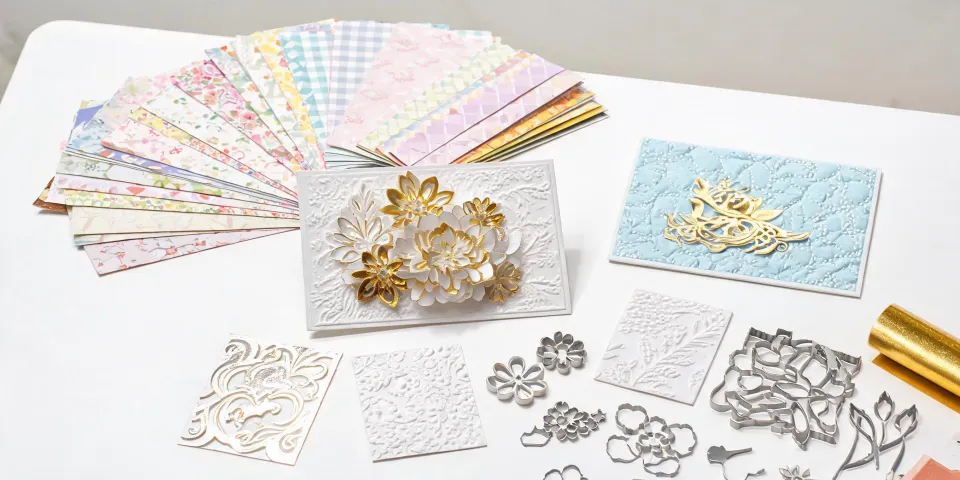
The difference appears in detailed designs: fine florals, intricate holiday scenes, small lettering. That's where steel depth and edge quality matter. A shallow die with a burred edge cuts fine for the first few passes, then starts lifting fibers or tearing the top layer.
In 2023, we ran a blind test with 25 craft retailers. On a detailed floral die, about 75 percent identified the branded die's cut as "cleaner" without knowing which was which. On a basic circle, nobody could tell. That matches what I'd tell any buyer: generic dies for basics, and invest in branded dies for anything with fine detail.