Every November, without fail, someone in our office asks me about standard greeting card envelope sizes. It sounds like a trivial question—and honestly, it kind of is. But it's also the gateway to a much bigger conversation about how we handle holiday cards, decorations, and the whole seasonal chaos that lands on my desk every year.
Actually, let me back up. I manage purchasing for a mid-size company—around 400 employees across three locations. Our annual holiday card order was one of those recurring tasks that looked simple on paper but ate up way more time, budget, and sanity than it should have.
The first year I took over purchasing in 2020, I figured I'd just order cards from a standard vendor like everyone else. But then came the questions: What size envelope? A2 or A7? Do we want a holiday figurine to go with it? Should the ornament be attached to the card? I learned a few hard lessons about paper craft sizes and postal regulations that I'm going to share here—so hopefully you don't make the same mistakes.
Why "Just a Card" Is Never Just a Card
So, the surface question: what size is a standard greeting card envelope? The answer seems straightforward. USPS defines letter-size mail as 3.5" x 5" minimum to 6.125" x 11.5" maximum, with a thickness of 0.25" maximum. Large envelopes (flats) run up to 12" x 15" and 0.75" thick. But a "standard" greeting card envelope? It depends on the card size.
In practice, the common sizes:
- A2 (4.375" x 5.75") for smaller thank-you / note cards
- A6 (4.75" x 6.5") for standard folded cards
- A7 (5.25" x 7.25") for larger cards that include inserts or thicker paper
Here's the kicker: the envelope size directly affects postage. A standard card in an A7 envelope might still fit within USPS letter dimensions, but if you add a small holiday figurine or any rigid ornament inside, it becomes non-machinable or even a parcel. That's when the per-unit cost jumps. According to USPS rates effective January 2025, First-Class Mail letters start at $0.73 for 1 oz, while large envelopes go up to $1.50. And if your envelope is non-flexible because you included some 3D accent, you're not paying letter rates anymore—you're paying parcel rates.
That's the real issue. People think "I'll just order cards online" and then get surprised by the logistics and the costs. But it goes deeper.
The Behind-the-Scenes Problem: Custom Cards Have Hidden Costs
Most administrative buyers discover the hard way that online printing platforms look cheap at first glance. I've worked with a roster of vendors for about eight different purchasing categories, so I know the drill. You see the base price, you multiply by the quantity, and you think you have your number. Then you hit the checkout page and discover:
- Setup fees, even for digital printing—anywhere from $15 to $50 per color for offset, though some online shops eliminated them.
- Die cutting setup fees if you want a custom shape: $50–$200 depending on complexity. That's a real thing when you're making die cut cards or holiday figurines.
- Rush fees: next business day +50–100%, 2–3 days +25–50%. Based on major online printer fee structures in 2025.
- Artwork / proof fees, which some vendors charge every revision.
Now, I'm not saying these fees are unjustified—I've seen the operational chaos rush orders cause. But they're often not transparent on the initial quote. We once ordered about 500 custom Christmas cards with a small die cut ornament shape. The base rate was reasonable. After setup, die cutting, and shipping, the total was almost 2.3x the initial estimate. Finance was not happy, and my expense report took a hit.
That experience took me maybe two more holiday seasons to fully understand. It took me about 3 years and 60–80 orders annually to realize that vendor relationships matter more than vendor capabilities when it comes to unpredictable seasonal inventory. And it took one particularly bad November to make me question the entire practice of outsourcing our holiday card production.
What It Really Costs to Get This Wrong
Let me lay out the failure modes I've seen, so the stakes are clear beyond "we printed the wrong size envelope."
1. The wrong envelope size = rejected mail. If you order a card designed for an A2 envelope but your vendor ships you an A6, or you simply didn't specify the envelope size at all, two things happen. First, you might pay more postage than needed because the envelope is larger. Second, if you stuff it with an ornament or figurine, the thickness may exceed the 0.25" letter limit. That's a recipe for delayed delivery—or non-machinable surcharges. I've watched holiday cards arrive after New Year's because of this. My boss didn't say much, but the silence was loud.
2. The seasonal stock dilemma. Holiday figurines and ornaments are highly seasonal items. If you're a company sending branded gifts or decorations to clients, you're at the mercy of supplier inventory. By the time you realize you're missing something, the stock is gone and the next supplier is two weeks out. In our 2024 vendor consolidation project, we moved to fewer but more reliable suppliers; however, even they ran into sell-throughs for certain figurines and decorative pieces.
3. The hidden processing time. Am I the only one who forgets that standard turnaround for custom printed cards is usually 5–7 business days, and that's before shipping? Add another day or two for proof approval. A simple "we need 800 cards by December 10" request actually requires a November 1 kickoff. That gap between internal stakeholder expectations and supply chain reality is a constant source of friction. To be fair, part of that is my job—managing expectations. But the vendor side could be more upfront, too.
4. The people factor. I have mixed feelings about this one. On one hand, I'm the one who's supposed to make things work. On the other, when the cards are cute and arrive on time, nobody remembers who ordered them. When they're late or the paper is flimsy, it's my name attached to the failure. It's a thankless category. That's part of why I started looking for more control over the process.
How We Changed Course: Bringing It In-House
Now, here's where I'd normally say "we switched vendors and everyone was happy." But that's not what happened. What actually worked was finding a solution that gave us flexibility, reduced per-unit cost, and eliminated most of the setup / die charge / minimum order problems.
After a particularly stressful holiday season, I started researching die cutting machines for craft production. I know—that sounds like a weird leap for an office administrator. But stick with me.
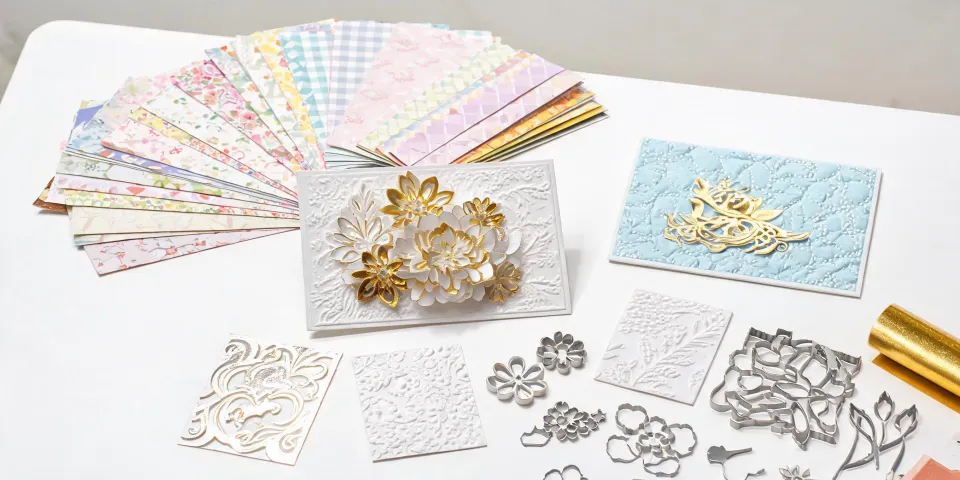
The Spellbinders Platinum die cutting machine is a standout in this niche. It's a wafer-thin steel-rule die cutting system that works with a ton of different die sets. It's not just for scrapbooking—spellbinders paper crafts includes custom cards, gift tags, envelopes, holiday ornaments, and even small three-dimensional figurines if you use the right materials and molds.
Why did this solve our problem?
- No minimum orders: if we need 400 cards, we make 400. If we need 40, we make 40. That flexibility alone killed the minimum order quantity (MOQ) issue we kept running into with commercial printers.
- No die cutting setup fees: once you have the dies, the marginal cost is essentially the paper and ink. We already have paper supplies in the office from other projects.
- Full control over dimensions: We can make cards that fit standard A2 or A7 envelopes, and verify the envelope size ourselves. No mismatch issues.
- Seasonal flexibility: Instead of hunting for that specific holiday figurine or christmas ornament from a supplier, our team can produce custom pieces that match our brand aesthetic. The Classic Mouse and City Holiday collections from Spellbinders, for example, are designed specifically for holiday themes.
A quick note on paper craft and postage: we always keep USPS guidelines handy. Spellbinders dies are typically designed to create cards that fit standard envelope sizes, so we haven't had a non-machinable surprise since.
Now, I should be careful here. I'm not going to claim the Platinum machine is the "cheapest" option or that it eliminated our entire vendor list. That'd be dishonest. If you need 10,000 cards, a commercial printer is still more economical. And if you're mailing to a huge list, outsourcing the addressing and mailing might still make sense. My experience is based on a mid-size company with roughly 400 employees and predictable seasonal needs. If you're a smaller team with no one to run the machine, the calculus might be different. But for us, bringing card production in-house with the Spellbinders Platinum die cutting machine was a game-changer.
Bottom Line
If you're an admin buyer and someone asks "what size is a standard greeting card envelope?"—that's not just a trivia question. It's a flag. It means the process is due for a review. Understand your postage costs, know the difference between a letter and a flat, and factor in setup fees and seasonal availability before you commit to a holiday card order.
For our office, the answer turned out to be a mix of better vendor management and an in-house setup that gives us control. Spellbinders die cutting made our holiday prep faster, more predictable, and honestly, the team enjoys the creative side of it. It's not the standard corporate procurement answer, but it's the one that worked for us.
If this approach might fit your situation, I'd recommend looking at the Spellbinders Platinum and their holiday collections. Don't wait until November to figure out your envelope sizes. And for heaven's sake, keep a ruler on your desk. It saves a lot of grief.