The Question Isn't Which One Is 'Better'
Every year around July, our inbox starts gathering the same question from retailers, print shops, and corporate gift buyers: should we add physical holiday products—holiday figurines, Christmas ornaments, die-cut greeting cards—or should we go the other direction and create personalized digital gift cards?
I used to answer with a wishy-washy 'it depends'—then immediately give my opinion anyway. After six years running seasonal and corporate gift production, I've stopped doing that. I've made eleven documented mistakes worth roughly $15,200 in wasted budget. Most of them weren't execution failures. They came from giving the wrong solution to the right question.
The truth is, there's no universal answer. The comparison shouldn't start with cost per unit. It should start with what the recipient will do with the gift. I now sort every new request into three scenarios. Find yours, and the decision gets much easier.
Scenario A: You're Making Something People Will Keep
If the recipient is someone who will unwrap the gift at a team celebration, hang it on an office tree, or place it on a desk for the whole season, physical products win. A Christmas ornament or a small holiday figurine does something a digital card can't do: it stays visible. It reminds the recipient of the giver every time they look at it.
I saw this clearly when we ran a side-by-side comparison for a corporate client in 2023. Half their managers received a die-cut holiday ornament; the other half received a digital gift card. The digital cards were redeemed fast—some within an hour. The ornaments ended up on desks, office trees, and in at least a dozen Instagram stories. One was a transaction. The other was a keepsake that kept advertising the client all season.
If that's your scenario, you don't need an argument for physical gifts. You need a production method that doesn't eat your margin.
Why the Spellbinders Platinum Scout die cutting machine made our shortlist
We bought the Spellbinders Platinum Scout die cutting machine two years ago for a simple reason: we needed consistent, repeatable die cuts without dedicating an entire production line to them. The Scout is compact enough to live on a regular craft bench, and it handles the kind of runs we actually get—200 to 500 pieces of greeting card fronts, ornament layers, and small figurine components.
Before that, we used manual methods for small batches. That still works for many makers, and I won't tell you otherwise. But when we needed consistent registration across a 400-piece order and the same holiday design had to look identical on every unit, the mechanical die cutter became the practical choice.
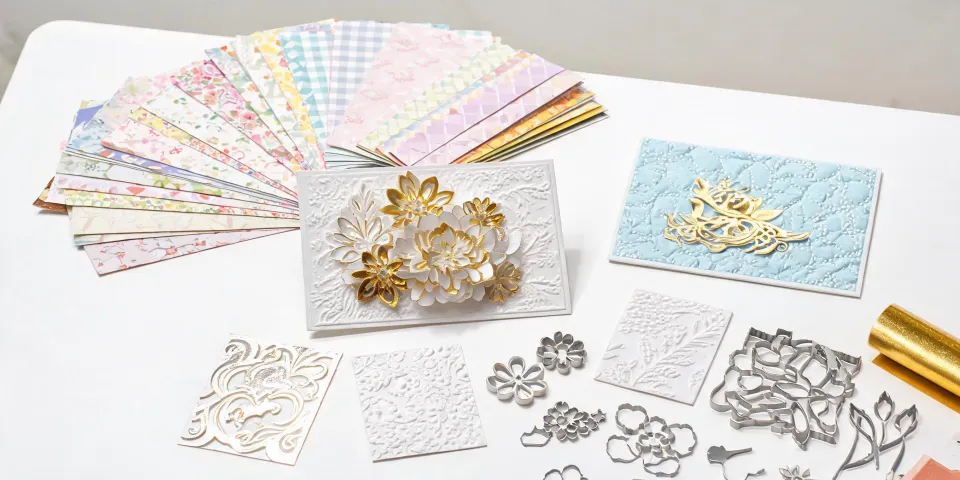
The dies matter just as much as the machine. The Spellbinders City Holiday collection is our default starting place for dimensional holiday projects. The dies in this collection let us build layered scenes and ornamental details that turn a flat card into something with real depth. When a client asks for a holiday figurine that feels like a quality keepsake rather than a paper cutout, City Holiday gives us a repeatable design language we can use year after year.
Run the postal math before you quote
Here's the mistake that still embarrasses me. We produced 400 oversized greeting cards with a die-cut ornament attached to the front. We priced postage at the standard letter rate because the card started as a 5x7 piece. But the ornament layers pushed the total thickness past the 0.25-inch maximum for letter mail, so every envelope had to go as a large envelope instead.
According to USPS pricing effective January 2025, a First-Class Mail letter (1 oz) costs $0.73, while a large envelope (1 oz) starts at $1.50. Additional ounces for large envelopes cost $0.28 each (Source: usps.com). The difference on that order was $0.77 per piece—$308 we quietly ate because we didn't check the thickness rule. USPS Business Mail 101 (pe.usps.com/businessmail101) is clear: a letter can be up to 6.125 inches high and 11.5 inches long, but only 0.25 inch thick. Past that, you're in flat territory.
Now every physical product quote we send includes a line for postal classification. It's not glamorous, but it keeps us out of the 'why is this order losing money' conversation.
Scenario B: The Gift Needs To Arrive Fast and Far
Sometimes physical is the wrong answer. If your recipients are scattered across five states, or the program is a last-minute incentive that needs to land in someone's inbox within the hour, don't ship a dimensional ornament. You'll pay for expedited shipping, pray nothing bends, and still miss the moment. For that kind of need, a personalized digital gift card is the right call.
But there's a trap here, and I nearly walked into it.
In late 2023, we were asked to create 150 personalized digital gift cards for a client's holiday staff reward. We designed beautiful holiday cards with the client's branding, wrote personal notes, and added a decorative code field on each one. The files looked fantastic. I reviewed them myself and thought, 'No recipient would confuse this with a real gift card—it's obviously a seasonal message.'
That was exactly the wrong thing to think.
The client's final question stopped the launch: 'These are actually spendable, right? They have real value?' They didn't. We had built 150 pretty images with no funding, no redemption process, and no gift card infrastructure behind them. Only that last question saved us from a very expensive embarrassment.
Where to create personalized digital gift cards, in practice
That experience taught me to separate design from infrastructure.
If the deliverable is truly a holiday message card with a personalized name and note, tools like Canva or Adobe Express are perfectly fine. You design, personalize, and send a PDF or image. But don't call it a gift card if it can't be spent.
If you need an actual digital gift card—something the recipient can redeem for value—use a platform built for corporate gifting. Tango Card and Giftbit are two examples we've used; they handle funding, delivery, and redemption, and they let you add your own branding and personalization. For retailers issuing gift cards for their own store, use the gift card system already built into your e-commerce or POS platform. Don't build your own. It's not a technology problem; it's a trust problem, and recipients will notice the first time a card doesn't work.
Per FTC advertising guidelines (ftc.gov), claims should be truthful and not misleading. That principle applies here more directly than people expect: if you market something as a gift card, make sure it functions like one. If it's an image with a greeting, call it a digital holiday card and stop there.
Scenario C: You Need Both—but With a Clear Rule
Most B2B gift programs eventually land in this third scenario. A corporate client might have 40 employees in one office and 60 remote workers in other states. One group will gather around a table, open gifts together, and appreciate a tangible ornament. The other group needs something that can travel digitally without friction.
The solution isn't to make both and hope for the best. It's to install a simple internal rule.
Our rule is: physical if the gift can be handed person-to-person at a gathering. Digital if the gift has to travel to the recipient on its own.
For that client, we produced a run of holiday figurines with the Spellbinders City Holiday collection for the 40 local employees, and we sent personalized e-gift cards through a corporate gifting platform to the 60 remote employees. The local gifts were unpacked together, photographed, and shared. The remote gifts were used quickly, which was exactly what they needed to do.
The mistake I see other buyers make is forcing one solution through both channels. A physical ornament sent by expedited courier to a remote worker is expensive and fragile. A digital card given to someone who is sitting right next to you feels impersonal. Match the gift to the moment.
How To Know Which Scenario You're In
Instead of a generic 'choose what fits best,' here are the five questions I now ask before recommending anything.
- Where are the recipients located? If they're all in one place or at one event, lean physical. If they're spread across regions, lean digital or hybrid.
- What response do you want from the gift? If you want it to be remembered and seen for months, physical. If you want it to be used and appreciated immediately, digital.
- What's your lead time? Physical production needs at least a week or two, plus shipping. If the timeline is under five business days, digital is the safer route.
- Do you have production capacity for consistent quality? If you're new to die cutting, don't buy a machine for a single rushed order. If holiday figurines and ornaments are becoming a recurring revenue stream, the Spellbinders Platinum Scout die cutting machine plus a City Holiday die set is a reasonable starting investment.
- Have you checked the mailing specs? For any physical order, verify weight, dimensions, and postage before you quote. The USPS rate sheets change, and the difference between a letter and a large envelope can wipe out your margin.
If you're still torn after those questions, I use a simpler phrase: physical gifts are for moments; digital gifts are for convenience. A gift you unwrap together creates a shared memory. A gift you use alone provides quick value. Both are legitimate. The mistake is choosing the wrong one for the situation.
Since we turned these questions into a pre-season checklist, we've caught 47 potential order errors in the past 18 months—wrong assortments, misclassified postage, and one digital gift card project that would have been a $2,700 refund disaster. I still make mistakes. I just make smaller ones now.
Prices and platform details are current as of January 2025; verify current rates before quoting. If your client needs a keepsake this holiday season, give them something they'll still find on a desk next July. If they need value to arrive fast, send a real digital gift card. Just don't confuse the two.