Last August, my purchasing colleague dropped a folder on my desk with three supplier quotes for 3,000 Christmas figurines. Taped to the folder was a Post-it that said, 'Or do we cut these ourselves?' She needed an answer before our client's Q4 gifting window closed.
I'm the person who reviews finished products before they reach customers. That means roughly 200 unique items a year, covering everything from packaging color to part alignment. In 2024 I rejected 6 percent of first deliveries for tolerance issues. So when my colleague asked which route to take, I treated it as a spec decision, not a craft decision.
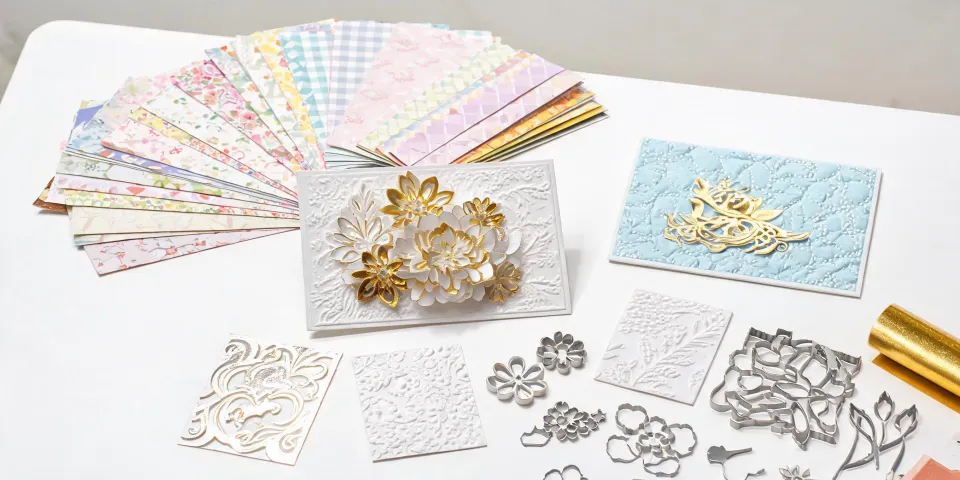
We ended up comparing two routes. Option A was the conventional one: buy pre-made holiday figurines from a wholesale supplier, add the client's branding, and schedule delivery from their stock. Option B was the internal one: use a Spellbinders cutting machine and the Spellbinders Classic Mouse Christmas collection to produce and assemble our own coordinating pieces. Four dimensions drove the comparison: unit cost, physical consistency, design unity, and calendar certainty. I'll tell you the awkward part upfront: the dimension I thought would decide it, cost, was not the one that decided it.
Our client had made one thing clear: the gifts had to be deliverable by the second week of December. Not 'around the second week.' The second week. That kind of deadline changes how you evaluate a price.
Dimension 1: Unit Cost at Our Real Volume
At face value, Option A looked stronger on paper. We received a wholesale quote around $1.40 to $1.60 per unit for a basic figurine (based on supplier quotes, June 2024; verify current pricing). That's hard to argue with when die sets and operator hours sit on the other side of the ledger.
But that quote assumed no logo. As soon as we asked for a custom printed belly badge, the supplier added a $900 setup fee plus $0.18 per unit. The stock route was not expensive because of its unit price; it was expensive because every brand customization came with an additional charge.
The supplier's minimum for a custom version was also 1,000 units. If our client had only asked for 200, Option A would have been the whole conversation. At 3,000, we had room to compare different economics.
The in-house estimate had its own surprises. Materials for a layered die-cut figure cost less than the wholesale piece, but labor was real. A run of 3,000 units meant something like 35 to 45 hours of die-cutting, sorting, and assembly. Take those numbers with a grain of salt, since material costs shift with the design. In our scenario, break-even landed somewhere between 600 and 800 units. Below that, buy the pre-made pieces. Above that, the in-house route became competitive even before counting the softer benefits.
Dimension 2: Consistency Is a Quality-Control Issue
The conventional wisdom in sourcing says a factory with QC staff will produce more consistent results than a small in-house workshop. I'm not sure that's true when the product is a holiday figurine with several assembly steps.
The supplier's pre-production sample of 20 figurines looked great. But a sample tells you what a factory can do, not what it will do at the end of a 40,000-unit run. Midway through our order, we found pieces with feet that didn't sit flush and facial details slightly outside our 1 mm alignment tolerance. The vendor called it 'within industry standard.' Put another way: it was within their standard, but our client's name was on the box, not theirs.
The inspection process also mattered. The supplier's QC checked for obvious breakage, not small visual details. When we raised the defect issue, their quality report measured the wrong dimension. I'm not sure the report was intentionally misleading; it was written around their line's tolerances, not our spec.
The die-cut route was not automatically perfect. Dies wear, cardstock changes thickness, and a misaligned cutting plate creates waste. But because the process was in-house, we controlled the variables. When the first piece looked right and the scoring stayed consistent, the one-thousandth piece looked the same. For a QC reviewer, that is a beautiful thing: fewer surprises.
Everything I'd read about sourcing said factories would be more consistent than an in-house team. In practice, one machine and one well-aligned die produced steadier dimensional quality than the vendor's production line. That still feels counterintuitive.
Dimension 3: Design Unity Across the Whole Gift
When you buy pre-made figurines from a catalog, you're buying someone else's aesthetic decisions. Those decisions might be polished, but the pieces arrive as individual products. If a corporate recipient opens the box and finds a figurine, a tag, and a card that come from different product families, the gift starts to feel like a pile of leftovers from a gift fair.
In our unboxing tests, recipients commented on that mismatch. Not always, but often enough. A cartoon mouse in a red scarf tends to sit on a desk for the rest of the season. If the tag says one style and the figure says another, people notice even when they can't explain what feels off.
One of the strongest arguments for using Spellbinders Classic Mouse Christmas was the visual system of the collection. The same mouse character carried through the line, which meant a gift tag, a card sleeve, and a layered figurine could be designed as a matching set. The art direction was already done. That made it easier for a non-designer like me to produce something that felt curated instead of assembled.
I'm not a designer, so I can't speak to beauty as well as our creative director could. What I can say from a quality perspective is that mismatched design styles create perceived defects. If the red on the figure's hat doesn't match the red on the envelope, customers will assume it's an error even when every dimension is within spec.
Dimension 4: Calendar Control and How to Schedule Personalized Gift Card Delivery
Now we get to the part that changed my mind. In September, Option A looked comfortable on schedule. Order by Oct. 15. Receive stock Nov. 10. QC for three days. Repack. Start shipping Nov. 28. That plan took about one email from the supplier to fall apart. The custom base required a second factory, and the ship date slid nine days. Our account team started calling about expedited freight, and the phrase 'probably still make it' was used.
Option B didn't remove the deadline. It just moved control of the deadline to our own shop. We scheduled production for November, built in QC review time, and set shipping dates we actually owned. That control is what I now call the time-certainty premium: the extra cost of doing it ourselves bought us a schedule we could rely on.
In a corporate gift program, the schedule question eventually becomes: how do we schedule personalized gift card delivery? This is not just an email automation task. If a prepaid card sits inside a die-cut holiday package, the entire order has a calendar. Production, personalization, packing, and shipping all have to line up.
One thing I wish we had known earlier: delivery scheduling is a window, not a date. The client wanted gifts to arrive between December 8 and December 15. We had to aim our production and logistics plan at the start of that window, not the end. The end is where delays hide.
The process that worked for us looked like this:
- Set a no-earlier-than arrival date and a no-later-than arrival date from the client. Usually 10 business days before the office closes works for domestic mail.
- Finish personalization before packing, and mark the packing date on the order. This prevents the gift card insert from waiting in a bin while the outer sleeves are packed around it.
- Measure the final envelope. According to USPS pricing effective January 2025, a First-Class Mail letter (1 oz) costs $0.73, and a large envelope (1 oz) costs $1.50 (source: usps.com). If the package exceeds letter size because of thickness, plan for the higher rate and the extra ounce.
- Choose a trackable service for anything with a gift card. Saved tracking numbers are easier to defend than a prediction that it should arrive.
One compliance note: if you use a private courier for last-mile delivery, do not instruct the driver to put the package in a residential mailbox. Under 18 U.S. Code § 1708, only USPS-authorized mail may be placed in mailboxes; violations can result in fines up to $5,000 per occurrence. I'm not a lawyer, so verify current rules before changing your fulfillment process.
Which Route Should You Pick?
If you need fewer than 300 units, don't need deep personalization, and have at least six weeks of buffer, the pre-made route is fine. Compare supplier quotes, inspect an actual production sample, and schedule delivery with a cushion.
If you need 500 or more units, want a coordinated holiday story, or keep watching vendor delivery promises slip, the in-house route deserves a serious look. A cutting machine is an equipment purchase. Consistency and calendar control are operational outcomes. Spellbinders crafts collections, especially the Classic Mouse Christmas theme in our case, gave us a design language that made the result feel intentional.
But don't buy a machine expecting it to solve a vendor relationship you haven't fixed. If you don't have space or people to operate it, the math doesn't work. The machine doesn't replace discipline; it rewards it.
In the end, my recommendation to my colleague was Option B for this order. It was not the cheapest option on the first spreadsheet. The real comparison was never Spellbinders vs pre-made figurines. It was certainty vs hope. For a 3,000-unit December delivery, I'll pay for certainty.