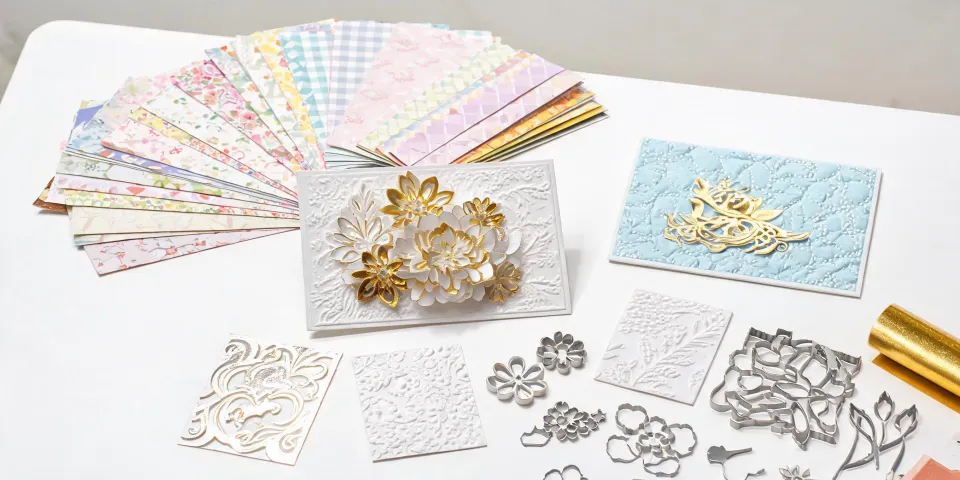
I'll start with an opinion that has gotten me into more than one argument at craft-industry meetups: your cutting machine is the most underrated factor in Christmas paper crafts. Not paper stock, not ribbon, and honestly not even the design. If the cuts aren't clean, the finished project reads as 'almost.' And 'almost' is a bad look when you're producing gifts for clients, building inventory for a holiday market, or making an ornament that will hang on someone's tree for the next ten years.
In my role coordinating production for a small paper-goods company, I've handled 200+ rush projects over the past 11 years. When I'm triaging a holiday order, I think about three things: time, feasibility, and risk. Quality sits above all of them because quality is what the recipient actually feels. This isn't a theory. It's the reason I now refuse to short-change the tooling side of Spellbinders paper crafts.
The Little Mouse Test
Here's what surprised me when I started working with the Spellbinders Classic Mouse Christmas collection. Those mice look simple—a scarf here, a tiny hat there—but the dies are detailed enough to expose any weakness in your setup. A worn plate, a loose magnetic mat, or a slightly-off cutting sandwich turns a charming mouse into a wobbly blob. I'm not a paper engineer, so I can't explain the metallurgy. What I can tell you from a production perspective is that the problem shows up in every single piece.
The question everyone asks is, 'Which cutting machine should I buy?' The better question is, 'Will this setup still cut cleanly after the 200th pass?' Because the first ornament is not the test. The 80th ornament, at 11 p.m., with your hand cramping and the deadline creeping closer—that's the test.
Quality Is a Brand Statement
Think about the last handmade Christmas ornament that made you stop and say 'wow.' I remember one from a craft fair in 2022: crisp die cuts, perfectly aligned layers, no rough edges. It felt special. That feeling came from the maker's skill, but also from their tools. The two are hard to separate.
Now imagine the opposite: a paper nativity scene where the stable's roofline is ragged, or a Christmas ornament with edges that look chewed. The recipient won't know the cutting machine was to blame. They'll just sense that something is off. That perception is hard to undo, and it attaches to your name, your shop, or your brand.
Your output is an extension of your brand. If it's inconsistent, no amount of clever design can rescue it.
The Math of Rework
I know the budget objection. It's tempting to think you can save by buying a cheaper cutting machine and discount dies. That's a reasonable instinct. But the math changes when you count rework. What I mean is that if a die set costs $40 and wrecks one in every dozen pieces, you're not just losing cardstock. You're losing time, focus, and the spare nerves you need for the rest of the project.
Example: in November 2023, a client needed 60 assembled Christmas ornaments—I want to say 60, but don't quote me on that—for a corporate gift bag. We were using a budget die set that I won't name. On the third pass, one of the dies bent. We caught it before it ruined the whole batch, but then we had to replace the die and pay for overnight shipping. Add about $65 to the cost—no, wait, $65 was just the shipping, the die was another $35. Either way, it hurt. If I had started with a die I trusted, that $100 could have covered most of the price difference. I paid a rush premium because I tried to save on equipment. Never expected that to be the lesson, but it was.
What About Scissors and Punches?
I can hear the counterargument now: 'I can do the same with scissors and a craft knife.' For simple shapes, sure. For a nativity scene with clean silhouettes? No. The problem is consistency. Hand-cutting creates tiny variations in every piece. In a batch of ornaments, those variations add up. In a nativity scene, they make the pieces look like they belong to different sets.
I'm not saying manual methods are inferior. I use scissors all the time. But there's a reason bakers use moulds for decorated cookies: you can freehand a cookie, but you won't get 50 identical ones. A cutting machine gives you repeatability. If your goal is a premium, finished product, repeatability is not optional.
A Better Answer to 'How to Set Up a Nativity Scene for Christmas'
I hear the question 'how to set up nativity scene for Christmas' a lot in my line of work. Most people think it's about arrangement—where the manger goes, how to angle the star, whether to put the wise men close or far. That's part of it. But the real answer, especially if you're making a paper nativity scene, begins with the cutting quality. If your pieces aren't clean, no arrangement will make them look intentional.
When I assemble a paper nativity scene, I do it in this order:
- Cut the stable and backdrop first. It's the visual anchor, so it needs the crispest cuts.
- Layer the main figures next. Start big and work down to the details. Use adhesive sparingly so the paper doesn't warp.
- Add the small details—stars, halos, straw—last. These are the details people notice up close. If they're clean, the whole scene feels premium. If they're not, they read as clutter.
This is also where a reliable die cutting machine earns its keep. You can cut a stable roof three times with a craft knife and hope it matches. Or you can cut thirty identical ones with the press of a handle.
When I'd Tell You to Skip the Expensive Setup
Let me be fair: not every project needs premium dies. If you're making a quick card for a coworker or a prototype that will never leave your desk, use whatever you have. The quality-perception rule only matters when the final piece is meant to represent you—a gift, a display, a product.
I also understand that budgets have limits. If you can't afford a full Spellbinders setup this year, you don't have to. Prioritize the pieces people will see closest and keep longest: one excellent Christmas ornament, one carefully assembled nativity scene, one striking card. That's better than a dozen projects that look 'almost' right.
As of November 2024, the Spellbinders Classic Mouse Christmas collection is still a staple on the Spellbinders website. Seasonal lines rotate quickly, so if you're planning a paper-crafted holiday around a particular mouse, verify that it's still available before you fall in love with a retired die. The design may live on, but the die might not.
Why I Keep Choosing Quality
I've been accused of being obsessive about equipment. Maybe I am. But I've also cleaned up enough last-minute disasters to know where the time really goes: not into the design, not into the paper choice, but into redoing cuts that should have been right the first time.
So here's my position, and I'm not softening it: if your Christmas paper crafts are meant to be seen, the cutting machine and dies matter as much as the design. The recipient won't know what brand you used. They won't know how many passes it took. They will know how it feels—clean and intentional, or slightly off. That memory stays with them longer than the price tag.
This year, I'm building my holiday projects around the tools I trust, including the Spellbinders Classic Mouse Christmas collection and a reliable cutting machine—mine is a Platinum, if you're curious. Not because I believe in spending for its own sake. Because I've seen how much difference a clean cut makes when someone holds a Christmas ornament in their hands. That moment is the whole point.