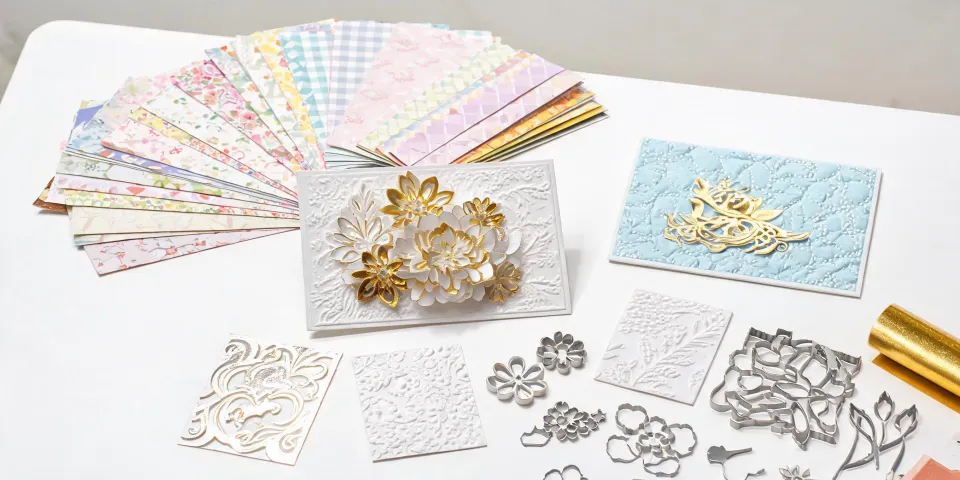
In late September, we got an order that felt routine until it wasn't. A corporate client in the Pacific Northwest wanted 500 holiday gift boxes. Each box would include a holiday figurine, a Christmas ornament, and a company note. They asked whether we 'handled corporate gift cards.' We said yes. That word-'cards'-was the first crack in the process. The client had a 500-person team and wanted something physical that felt premium, not like a branded chotchki. So the bar was already high.
As the quality manager at our studio, I've reviewed roughly 200+ unique gift and craft items a year for the last four years. This wasn't my first corporate order. But it was the first time I had to think carefully about the actual meaning of the phrase 'what is a corporate gift card?' I'll get back to that.
Why We Chose the Spellbinders Grand Calibur
For runs under 1,000 pieces, our most flexible production tool is the Spellbinders Grand Calibur die cutting machine. It's a manual roller press. You stack a cutting plate, a die, your paper, and another plate. Crank it through, and you've got a crisp shape. It's a staple in the Spellbinders paper crafts world. While many crafters use it to cut cardstock for scrapbook layouts, we use it as a micro-factory for small batch production. We've made wedding invitations, retail displays, and even museum reproductions with the same setup.
Here's what I've come to believe after running dozens of small batches on the Grand Calibur: for complex dies, this machine is nearly unmatched at our scale. The detail on a holiday figurine-a snowman's scarf, a bird's wing-comes out clean every time, provided you set the pressure correctly. Did I always think that? No. I spent years assuming that 'craft machines' were toys. Honestly, I was wrong. The Grand Calibur's 'Platinum' line from Spellbinders is designed for durability. We've used ours for years.
The Batch That Went Wrong
We designed two items for the client:
- A holiday figurine-a snowman with a flocked scarf and a little bird on his arm.
- A layered Christmas ornament-a star with a die-cut 'Season's Greetings' in the center.
Both were cut on the Grand Calibur using Spellbinders dies. We set up the production line, and on day one we produced 200 complete sets. At the end of the day, I pulled three boxes for inspection. The ornament's center star had a soft edge. The die had clearly not cut completely through one layer of the 110lb cardstock. It wasn't visible from two feet away. Up close, it was a deal-breaker for a premium gift.
I walked to the operator. They'd adjusted the pressure setting because the cutting mat was 'clicking.' A small change. A total mistake. We rejected the first 200 sets. That meant two days of rework. Not ideal, but workable.
At that point, I went back and forth for a full day about whether to outsource the remaining 300 sets to a commercial shop. Outsource offered faster turnaround, but would cost nearly double in per-unit price and we'd lose control over the hand-finishing. In the end, I stuck with the Grand Calibur but added a mandatory pressure-check sign-off before every batch. A lesson learned the hard way. The rework wasn't just about re-cutting. We also had to strip down the 200 sets we'd already assembled, reclaim the unused pieces, and track the scrap. That's a separate lesson in work-in-process control. The client was patient, mostly because we flagged the issue before it shipped. But it was a reminder that a quality problem is never just the operator's fault.
The Corporate Gift Card Confusion
While we were re-cutting, I joined a call with the client to talk about their inserts. The account manager asked if they wanted to include a printed holiday greeting card. The client paused. 'No, we want to include a gift card.' I remember the silence. 'What is a corporate gift card, exactly?' I asked. The client explained that they wanted a $20 Starbucks gift card in every box as a thank-you to their employees. They weren't asking us to print a card. They were asking whether we could integrate a pre-paid retail gift card into our packaging.
It sounds obvious in hindsight. But in the custom gift world, 'corporate gift card' can mean two different things. It can mean a greeting card with a corporate logo and printed message. It can also mean a stored-value card, like the Starbucks or Visa gift cards you buy at a grocery store. We quoted the first. They wanted the second. Nobody clarified the definition.
We fixed it. We added a small pocket to the box that could hold a plastic gift card. The client already had the gift cards ready, so the change didn't delay delivery. But it changed our internal process. We now split 'printed holiday card' and 'gift card slot' into two separate line items in every proposal. That single clarification can save a $22,000 order from becoming a joke.
When the Grand Calibur Isn't the Answer
This experience reinforced what I tell customers all the time: no single die cutting machine is 'best.' The right answer depends on volume, timeline, and risk tolerance.
For a small batch of 500, the Spellbinders Grand Calibur is genuinely a great fit. It gives sharp, repeatable cuts on holiday figurines and Christmas ornaments without a huge setup charge. Dies are relatively affordable, and you can switch designs in minutes. If you produce short-run corporate gifts, it's a serious production asset.
But if you're scaling to 5,000 or 10,000 units, my recommendation changes. The Grand Calibur is labor-intensive. It needs an operator per machine. It's not designed for 24-hour production. At that scale, a commercial die cutter with a rotary press or a cutting plotter is a better investment. There's nothing wrong with that honest limitation.
Cost is part of it too. For reference, I checked custom holiday card pricing at major online printers in January 2025. A printed, folded, 4.25 x 5.5 inch card in a run of 500 was roughly $0.72 to $1.50 per card before shipping. Our in-house die-cut greeting card cost about $0.45 in materials, but we added $1.80 in labor for folding, packing, and quality checks. So the DIY route isn't automatically cheaper. It's a tradeoff, not a victory.
The lesson isn't 'this machine is the best.' The lesson is 'know your volume and your process.' - my production notes, after the rework.
What I'd Do Differently Next Time
Three years ago, I would have oversold the Grand Calibur. Now I understand that quality comes from the process, not the equipment. We rejected 200 sets because a small pressure change broke our tolerance. The machine could handle the job. Our process couldn't. After we fixed the process, the final product matched the sample exactly.
And when a customer asks, 'Do you handle corporate gift cards?', I now send back two questions:
- Do you mean a printed greeting card with your logo?
- Or do you mean a stored-value gift card that needs to be included in the packaging?
Both are nice gifts. But they lead to completely different deliverables. Get the definition in writing before you cut anything.
If you're planning a corporate holiday order and considering Spellbinders paper crafts for your holiday figurine or Christmas ornament, go for it. Just verify your pressure, and ask about the word 'card.' Trust me on this one.
Prices mentioned reflect major online printer quotes, January 2025; verify current rates.