-
Is the Spellbinders mini die cutting machine enough for a small gift shop?
-
Which Spellbinders die cutting machines should a gift shop start with?
-
Can Spellbinders die cutting machines make Christmas ornaments for resale?
-
What is a personalized gift card?
-
Is in-house greeting card production cheaper than buying wholesale?
-
What hidden costs come with Spellbinders die cutting machines?
-
Why should I care about color matching for custom cards and Christmas ornaments?
-
How do I order Spellbinders products without getting treated like a small buyer?
I'm a procurement manager at a 19-person gift and paper goods company. I've managed the supplies and production budget—roughly $54,000 a year—for six years, and I've logged every order for Spellbinders machines, dies, and paper stock in our cost tracking system. This FAQ is for small retailers and gift shops asking the same questions I did before I bought that first die cutting machine.
Here's what I'll answer:
- Is the mini machine enough for a gift shop?
- Which machine to start with
- Making Christmas ornaments for resale
- What a personalized gift card actually means
- Hidden costs and total cost of ownership
- Color standards for custom cards
- How to order without getting treated like a small buyer
Is the Spellbinders mini die cutting machine enough for a small gift shop?
For most small shops: yes, if you're honest about your volume. The mini machine is enough for greeting cards, gift tags, small ornaments, and most personalized gift card work. It uses less bench space, costs less upfront, and is easier to train someone on. But 'enough' depends on how many identical pieces you need. If you're producing 200 of the same ornament in a single sitting, a larger machine like the Platinum series lets you process bigger dies and bigger sheets. The mini will make you do more repetitions.
There's a misconception that a bigger machine creates better results. It doesn't. A clean cut comes from a well-matched die, the right cardstock, and a flat, even pressure. The machine is just the platform. A mini machine will cut a well-designed die cleanly if the paper is right. That's why I tell buyers to stop comparing machine sizes and start comparing die libraries and paper compatibility.
My experience here is based on about 65 orders of Spellbinders equipment and materials across six years. If you're doing high-volume packaging or thick materials, your results will differ. But for a gift shop, the mini is usually the right place to start.
Which Spellbinders die cutting machines should a gift shop start with?
Start small. It's the procurement version of renting before you buy. If most of your products are A2 cards, tags, or ornaments that fit within a 5x7 area, a portable mini machine will cover your first six months. Use it to test seasonal collections, prototype custom orders, and build a die library that actually moves. Then, when a product line proves itself, add a larger Spellbinders machine and expand into bigger formats.
One note on compatibility: not every die fits every machine. Check the platform's size limits before you order a bundle. A die that works in a mini machine might also work in the Platinum series, but you need to verify that before promising a client a custom shape.
Also, budget for the die library before you budget for the machine. The machine is the tip. In our first year, dies cost us more than the machine. That's not a reason to avoid the category; it's a reason to plan for it.
Can Spellbinders die cutting machines make Christmas ornaments for resale?
Yes, and it's one of the better margins we've found. In Q4 2024, we made 400 Christmas ornaments using Spellbinders dies, heavy cardstock, and ribbon. Our materials cost about $1.20 per ornament—cardstock, ribbon, plus a per-run allowance for the die itself. The labor added $3.60 because each piece had to be cut, assembled, and packaged. True cost: $4.80 each. We sold them at $12, so the margin was solid. But the labor number surprised us. If I hadn't tracked it, we would have underpriced the line.
For ornaments and gift tags, use at least 80 lb cover (216 gsm). That's about business card weight. Anything thinner will look cheap and won't hang well. This is a print-industry standard, not my preference.
This pricing was accurate as of Q4 2024. Paper prices change fast, so verify current paper and ribbon costs before you set your retail price.
What is a personalized gift card?
In the craft and gift industry, a personalized gift card is a small custom card with a name, message, or photo on it. It's not a stored-value gift card. It's the die-cut gift tag that says 'The Parkers,' a thank-you card with a customer's initial, or a 'good luck' card for a specific person. It can also be a small printed card tucked into a gift box to make the gift feel custom.
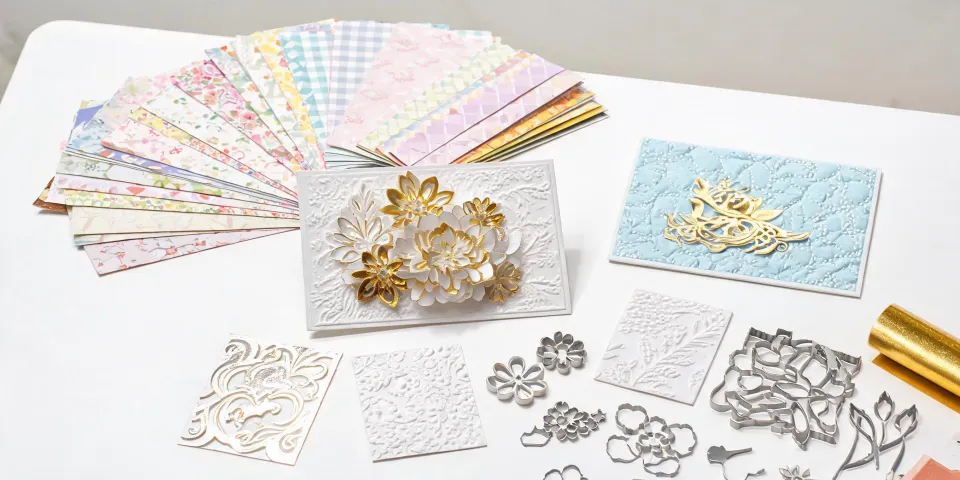
This is where a Spellbinders mini die cutting machine shines. You can cut names, messages, and shapes directly from cardstock without ordering a hundred custom-printed cards. For a B2B gift shop, personalized gift cards are an easy upsell: corporate clients request them for holiday gifts, employee boxes, and client appreciation. You can make 50 custom cards on demand, with no setup fee and no minimum order quantity.
If you're printing your own designs onto the cardstock, remember that commercial print resolution is 300 DPI at final size. A 6 by 4 inch card should be at least 1800 by 1200 pixels. Don't rely on a screen to judge how it will print.
Is in-house greeting card production cheaper than buying wholesale?
Sometimes. In our wholesale buying, greeting cards average $1.50 to $3.50 each. The materials for a die-cut greeting card—blank cardstock, envelope, die amortization, ink—can run $0.75 to $1.50 per card. The catch is labor. If your staff spends 15 minutes assembling a card, that's not 'cheaper.' It's cheaper only if you value your time at zero.
Our rule: if a design is standard and we expect to sell more than 100, buy it wholesale. If it's personalized, limited edition, or made for a specific corporate order, make it in-house. This rule saved us about 15% of our greeting card budget in 2023.
The 'in-house is always cheaper' thinking comes from an era before digital printing made small custom runs affordable. That's changed. You're no longer choosing between a full custom print run and buying blank cards. You can make just enough to test a design.
What hidden costs come with Spellbinders die cutting machines?
The usual suspects: dies, cutting plates, storage, shipping minimums, and waste. Dies are the biggest one. A collection of seasonal dies can quietly eat your budget if you buy for a whole release instead of the two or three shapes you know will sell. After tracking 65 orders, I found that 22% of our craft production spend was material that sat unused. We changed our policy: no die gets ordered until the design passes a test run, and no seasonal collection gets a full die set until we've sold the first batch. Our overruns dropped by about 18%.
There are also less obvious costs. Assembly labor. Packaging. The extra dies you add just to hit a free shipping threshold. That 'free setup' offer from a supplier? It cost us more in hidden fees once shipping and minimums were included. The same mindset applies in your own shop: setup isn't free, it's your staff's time.
Even after we chose the full-size Platinum machine, I second-guessed the decision. What if the mini would have been enough? The first 90 days of utilization data were stressful. Then the holiday rush hit, and I stopped worrying. The point is: the machine was not where we overspent. The dies were.
Why should I care about color matching for custom cards and Christmas ornaments?
Because corporate clients care, and the standard is stricter than you think. Industry color tolerance is Delta E < 2 for brand-critical colors. Delta E of 2 to 4 is noticeable to trained observers; above 4 is visible to most people. Reference: Pantone Color Matching System guidelines.
If a client asks for a 'deep red' for their Christmas ornament or a 'navy blue' for their personalized gift card, don't eyeball it from a monitor. Test the cardstock against a Pantone swatch before you promise a match. Screens lie. Paper reveals the truth.
How do I order Spellbinders products without getting treated like a small buyer?
Find the right distributor, not just the closest one. Some wholesale suppliers require a $500 initial order. Others let you start with one machine and three dies. Guess which one still gets our larger orders today? When I was starting out, the vendors who took my $200 orders seriously are the ones I still use for $20,000 orders. Small doesn't mean unimportant; it means potential.
Don't be afraid to ask for split quantities across die designs. A good supplier will let you test two or three ornaments and a greeting card design with a handful of dies instead of forcing you to buy an entire collection. And if you need personalized gift cards for a one-off order, you can make 50 in-house with a mini machine instead of paying a custom print setup fee. That's the beauty of this category: the tool pays for itself the first time you avoid a minimum order.