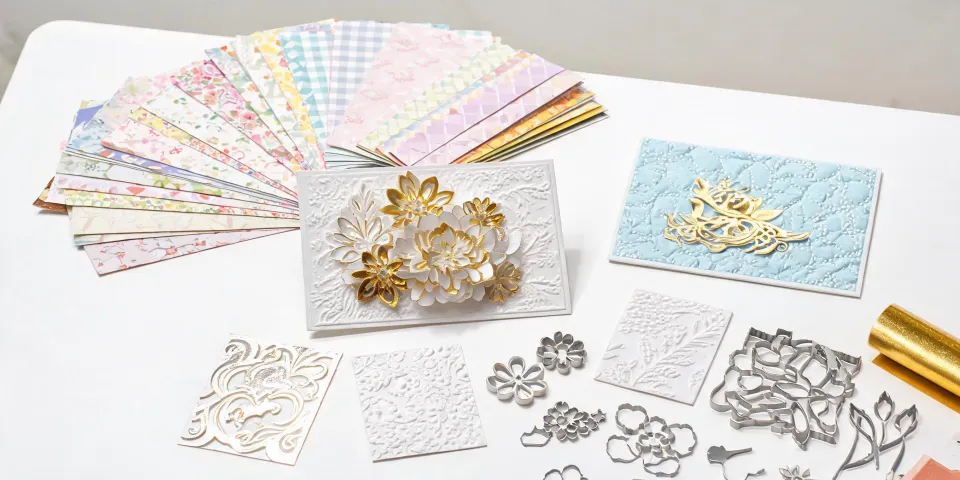
Last fall, after we closed the books on our Christmas line, I pulled the procurement spreadsheet and stared at it for ten minutes. We spent 18% more on seasonal greeting card components than the year before. We didn’t buy a new machine. We didn’t add a SKU. Order quantities were almost flat. So where did the money go?
That question is why I’m writing this. A single bad vendor would have been easy to fix. The real problem was a series of small buying decisions that looked sensible in June and made no sense by December.
The Problem You Think You’re Solving
When I get a request to source a die-cutting machine, the conversation starts with the machine price. The budget owner wants to know if the Spellbinders Platinum Six die-cutting machine is worth the cost, or whether a cheaper machine will do the same thing.
I don’t start with the machine price. I start with the purchases that follow it: dies, cutting plates, card stock, adhesive, packaging, and the labor to turn all of it into a finished greeting card or Christmas ornament. The machine is a fixed cost. The operating costs around it are where budget overruns live.
When someone asks me about the Spellbinders Platinum Six die-cutting machine, I treat it as a system purchase. The real cost is not what the checkout page says. It is what every completed gift costs by the end of the production run.
The Deeper Issue Is the Process
For years, I made the same mistake. I treated each line item as independent: buy machine from vendor A, dies from vendor B, cardstock from vendor C, ribbon from vendor D. Each one had a fine price. But no one owned the full process from raw material to packaged greeting card.
A run of Spellbinders Christmas cards has a defined sequence: die configuration, plate pressure, cardstock direction, scoring line, fold order, adhesive application, assembly, envelope size. If that sequence is not documented, your team has to improvise. That improvisation is the hidden budget killer.
Christmas ornament work adds another layer. Small dies show process gaps faster than a simple square label ever will. If the die is positioned wrong or the cardstock grain fights the fold, scrap appears before the ornament is fully shaped.
To be fair, no machine can fix a missing process. The tool does what the setup tells it to do. The surprise wasn’t that the more expensive machine cut better. The surprise was how much of my budget was tied up in the undefined space between machine, die, material, and labor.
What Ignoring This Costs
Here is a concrete number from my tracking spreadsheet. I approved a value die starter set that saved $300 on the initial quote. It cut well for the first 200 greeting cards. Then it dulled, tore, and made scrap that jammed our ornament assembly. By the time we stopped, the rework cost more than $1,200. The $300 saving turned into a loss of roughly $900, plus schedule time.
That was not the die maker’s fault. It was mine. We had no written process for matching die life to the production run. And that mistake repeated in different forms until I created a real approval checklist.
Mailing is another hidden cost. A beautifully finished greeting card can still be an expensive mail problem. According to USPS pricing effective January 2025 (usps.com/stamps), a First-Class Mail letter up to 1 oz costs $0.73, while a First-Class Mail large envelope up to 1 oz costs $1.50. If your card thickness or envelope size changes its postal category, the per-piece postage jumps before you have even addressed one envelope.
What I Changed
I don’t have a magic system. I have three rules that stopped most of the budget bleed.
- Standardize on one die-cutting ecosystem. For our holiday line, that means Spellbinders dies and a compatible machine such as the Platinum Six. This is not brand loyalty. It is repeatability. When every die fits the same cutting plates, process mistakes drop.
- Write the product spec before buying material. A greeting card or Christmas ornament should have a spec sheet that says which stock, which die, which adhesive, which envelope, and which USPS class it targets. If the spec would not fit on one page, we are not ready to order.
- Track total cost per finished unit, not unit price. The lowest quote is a bait number if it ignores setup, scrap, rework, and overtime.
Granted, this requires more upfront work. But cost overruns now appear when they are still spreadsheet cells, not finished inventory waiting on a loading dock.
Know What You’re Not Good At
One of the best budget decisions we made was defining what we are not good at. A colleague asked me, which throw pillow covers are machine washable? I laughed because I don’t know. Then I realized that is the right answer. I don’t buy textiles. I don’t test wash cycles. If I tried to sound helpful, I would be guessing with someone else’s budget.
A supplier that claims to know everything is a red flag. The vendor who says that isn’t our strength, here is who does it better earns trust for every other order. I’d rather work with a specialist who knows their limits than a generalist who overpromises.
Bottom Line
If your seasonal costs are out of line, stop looking at the machine and look at the system around it. The Spellbinders Platinum Six die-cutting machine will not save a broken process. And the right process will not force you to buy every accessory in the catalog. Define the job, measure the finished greeting card or ornament, and keep the purchase inside a platform you can actually run.