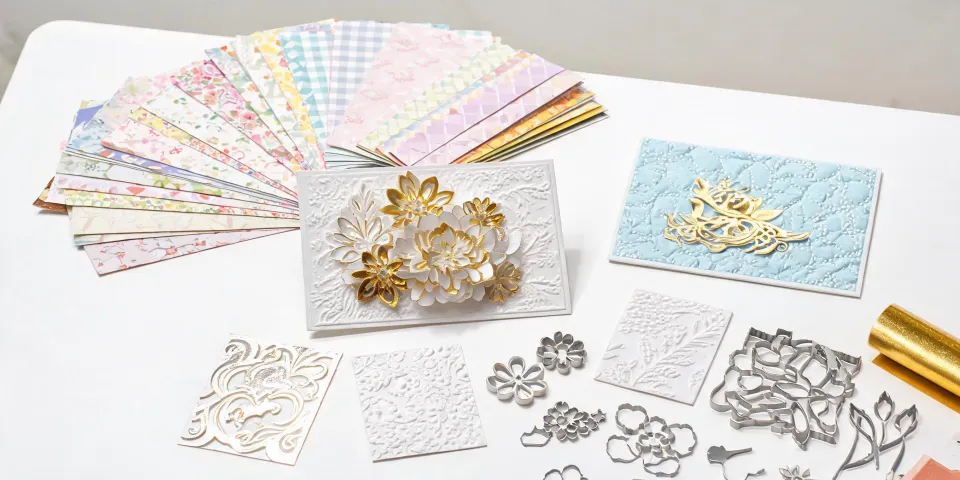
There is no universal answer to this question. If you're comparing a Spellbinders electric die cutting machine with a fiber laser cutting machine, you're looking at two tools that both cut, but they solve different problems. The right choice depends on what you make, what you sell, and how much rework you can tolerate.
I manage custom greeting card and ornament orders for a living. In six years, I've made and documented 14 significant mistakes that added up to about $7,300 in wasted materials and rework. The most painful ones happened because I picked a cutting tool that sounded more advanced than the job required.
So here's the structure for this article. If your product is paper, you're in one situation. If your product is a Christmas ornament made of wood, acrylic, or metal, you're in another. If your product line mixes both, you're in a third. The machine that works for one may be a bad investment for the other.
A quick reality check
Before deciding, understand what you're actually comparing. A Spellbinders electric die cutting machine uses formed steel dies to cut paper, cardstock, and other thin craft materials. It's repeatable, quiet, and doesn't produce fumes. A fiber laser cutting machine uses a focused laser beam, usually at a wavelength around 1064 nanometers, to melt or vaporize metal. It's powerful, fast for metal, and entirely overkill for paper.
People often search for 'what is fiber laser cutting machine' because they see a video of a laser cutting intricate shapes and assume it's the next level of die cutting. It isn't. Fiber lasers are industrial tools for metal work. Most wooden Christmas ornaments are cut with CO2 lasers, not fiber lasers. Keep that distinction in mind before you spend thousands.
Scenario A: Your core product is greeting cards
If you're making greeting cards, wedding invitations, or paper ornaments, I strongly recommend a Spellbinders electric die cutting machine over a fiber laser. Here's why: die cutting creates a clean, consistent edge without scorch marks. A laser can cut paper, but it can also leave a burnt edge or a smell, depending on the cardstock. On a 1,000-card order, that burnt edge becomes a quality complaint on every single piece.
I learned this the hard way in September 2022. I accepted a rush order for 700 custom greeting cards and decided to run a test batch on a CO2 laser because I wanted to find a faster process. The laser cut fast, but every card edge had a faint brown scorch. We had to redo the entire run with a die cutter. That mistake cost $890 in materials and a week of goodwill. A die cutting machine like the Spellbinders Platinum series would have handled the job quietly from the start.
One more production tip for greeting cards: think about postage before you add layers. According to USPS Business Mail 101 (pe.usps.com), a standard letter has to stay no larger than 6.125 by 11.5 inches and no thicker than 0.25 inches. A large envelope can be up to 12 by 15 inches and 0.75 inches thick. As of January 2025, a 1 oz First-Class Mail letter costs $0.73 per usps.com/stamps. If your finished card exceeds those dimensions, the postage bill surprises clients.
In this scenario, I'd also say this: buy official dies. I once bought a lot of 'compatible' dies that looked fine in photos but had uneven cutting edges. They ruined a batch of 200 card fronts. The official Spellbinders logo on the packaging isn't a guarantee of perfection, but it's a quick filter against counterfeits.
Scenario B: Your core product is a Christmas ornament in wood, acrylic, or metal
This is where I have to be honest about limitations. A Spellbinders machine is excellent for paper and thin craft materials. It is not a saw, and it's not a laser. I once tried to force a die through a piece of thin balsa wood. The wood splintered, the die lost its edge, and I had to replace it. That mistake taught me to respect material limits.
For wooden ornaments, a CO2 laser is the typical workshop tool. It cuts 1/8 inch birch plywood cleanly and can engrave names and holiday designs in the same pass. For acrylic ornaments, a laser is also the standard. For metal ornaments, a fiber laser cutting machine is the right choice because its wavelength is absorbed well by metals, which allows for clean cuts and engraving on stainless steel, brass, and aluminum.
Here's the counterintuitive part. Buying a fiber laser cutting machine because you make ornaments is not automatically an upgrade. It only makes sense if your ornaments are metal. I know a shop owner who bought a fiber laser for $4,600 because he wanted to expand from wooden ornaments into stainless steel keychains. That machine sat unused for nine months. His paper and wood orders kept running on the old equipment. The machine wasn't bad. The timing was.
Scenario C: You run a mixed B2B craft business
If you take orders for both greeting cards and custom ornaments, you might eventually need both a die cutter and a laser. But you probably don't need both on day one. Start with the tool that matches your highest-margin product. Add the second machine only when a customer order pays for it.
The mistake I see from other B2B crafters is buying for a wish list instead of a work list. I did it myself. In 2021, I spent my entire equipment budget on a laser because I was nervous about missing out on laser-cut ornament trends. Meanwhile, my greeting card orders piled up because I was still cutting everything by hand. A dedicated die cutter would have been the no-brainer purchase. The laser, in that moment, was a distraction.
If you run a mixed shop, ask three questions before buying anything. What material is your best-selling product? How many pieces do you usually need to produce per week? What is your rework rate on that product? If paper answers the first question, start with a Spellbinders. If wood or acrylic answers it, start with a CO2 laser. If metal answers it, start researching fiber laser cutting machine options.
How to decide for real
The way to decide isn't to read more product reviews. It's to run a small comparison test. Take a 100-piece greeting card order and run it on a Spellbinders electric die cutting machine. Take a 100-piece wooden ornament order and run it on a laser. Track three numbers: setup time, waste, and rework. Those numbers will make the decision obvious.
If you still feel stuck, ask yourself which customer keeps coming back. The client who orders 500 Christmas ornaments every November is telling you where to invest. The client who orders 1,000 greeting cards in March is telling you something else. Listen to the repeat orders.
To be fair, there are shops that justify owning both. Once you've got the volume, a dedicated die cutter for paper and a laser for non-paper materials is a strong combination. But buying both at once is how tools become expensive shelves.
The bottom line: there is no best machine, only the best machine for your product. If your money comes from paper greeting card orders, a Spellbinders electric die cutting machine is an easy recommendation. If your money comes from metal ornaments, a fiber laser cutting machine is worth serious attention. And if you're still not sure, run the test, track the costs, and trust the data.
Take it from someone who keeps a mistake log: the right tool for the right material is the cheapest way to make something worth selling.