I'm going to say something that won't win me any friends among certain suppliers: if you treat small orders like a nuisance, you don't have a small-order problem. You have a growth problem.
I've been handling gift and craft orders for nine years. In that time, I've made 34 documented mistakes—I keep a spreadsheet now, which is its own sad story—and roughly $4,300 of that waste came from orders I mentally dismissed as "too small to matter." That's not a proud number. But it's an honest one.
Here's the lesson I had to learn the hard way: small orders aren't a detour on the road to better clients. They are the road.
I Was the Small Client First
In 2017, my first year in business, I needed a supplier for greeting cards for a corporate pilot program. Forty-two cards. Not 4,200—42. I requested a quote and got a response that essentially said, "Minimum order is 500. Come back when you're serious."
I found another supplier. They took my $200 order seriously, made the cards, and delivered on time. Today, that supplier receives $20,000+ in business from me each year. The supplier who dismissed me? They don't miss me. But they're missing a lot of other former "small" customers too.
The embarrassing part: after I grew, I started running my own production line. And I caught myself doing the same thing they did.
In October 2022, a customer asked for 60 holiday figurines. The details were clear, the timeline was reasonable, and I almost pushed it to the bottom of the queue because—honestly—it didn't feel worth my time.
Then I skipped my own specification checklist because "it's only 60 units." The cardstock thickness was wrong, the die cut edges were ragged, and the figurines looked like somebody's craft project instead of a professional product. I shipped them anyway. The customer didn't complain. Which made it worse.
The order cost me $890 in wasted materials and a week of my team's time. But the real cost was the lesson I almost didn't learn: every order is someone's test.
What Most People Don't Realize About Small Orders
Here's something suppliers won't tell you: small orders aren't unprofitable because they're small. They're unprofitable when your setup costs are high.
Traditional craft manufacturing requires significant setup—calibrating equipment, mounting dies, changing material rolls. A 50-unit run looks absurd when setup takes four hours and costs $300 in changeover waste. That's why so many suppliers institute minimum order quantities. It's not customer snobbery. It's broken economics.
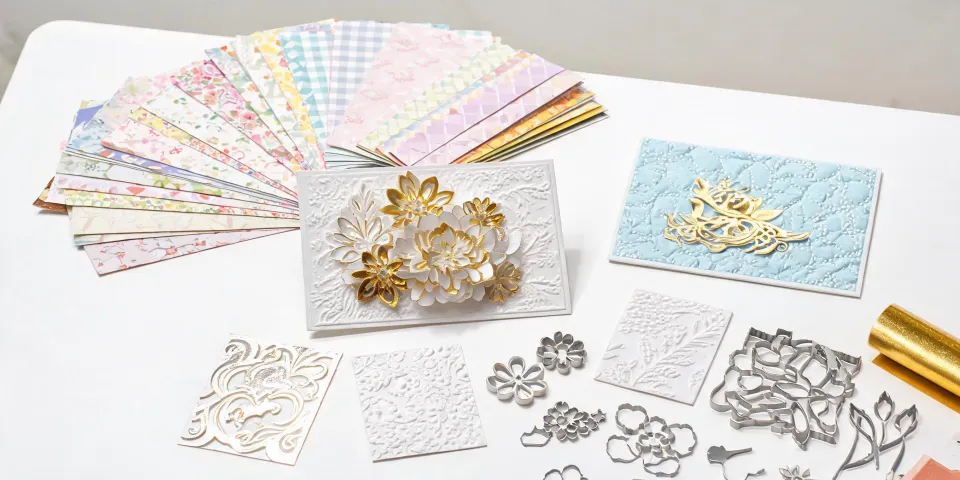
But the economics changed. The Spellbinders Platinum Scout die cutting machine made small-batch production genuinely viable. Setup takes minutes instead of hours. It handles a wide range of materials—from lightweight cardstock for greeting cards to heavier stock for holiday figurines and gift tags. And the dies are compatible with Spellbinders' broader ecosystem, so when a client comes back with a reorder, the setup is already saved.
Here's the insider math: when your setup cost approaches zero, a 40-unit order stops being a "small order." It's just an order.
I want to pause on the paper-weight lesson, because it's one of the most common greeting card mistakes I see. Lightweight cardstock (about 80 lb text / 120 gsm) is fine for standard cards, but for holiday figurines and gift tags, you want something closer to 80 lb cover / 216 gsm—about double the thickness, and it holds a die cut edge far better. That's a basic paper weight conversion, but I've lost at least one small order to getting it wrong. It looks fine in the stock, fails in the hand.
The Budget Question
"But small clients are cheap." I hear this. I used to believe it. Then I ran the numbers.
At the end of Q3 2023, I sorted every account by initial order value and looked at three-year lifetime value. Clients who started with orders under $500 generated 40% higher lifetime value than clients who started above $3,000.
Why? The small-start clients weren't price-shopping. They were testing. They were validating a pilot program, or a retail shelf idea, or a holiday bundle. Once they confirmed it worked, they scaled—and they didn't renegotiate aggressively when they scaled, because we'd already proven the quality.
They also referred other small businesses. Craft retailers who needed greeting cards and figurines on a reorder cadence. That network effect doesn't show up on a single invoice. It shows up as compounding demand.
The big-start clients, by contrast, were almost always sourcing a product they'd already bought last year. They knew what they wanted—and they knew the price they'd paid. They weren't building a relationship. They were negotiating a purchase. There's a difference.
What We Started Doing Differently
After the October 2022 figurine disaster, I put a process in place. Here's the thing that changed everything: no order, regardless of size, skips the quality checklist. We've caught 47 potential errors using that checklist in the past 18 months. That's 47 redo orders that never happened—and roughly $8,000 in rework we didn't eat.
The checklist is intentionally specific. Cardstock gets weighed against a conversion chart (80 lb text is 120 gsm; 80 lb cover is 216 gsm—they are not interchangeable). Any color-critical order is checked against a Pantone reference, and we hold the line at Delta E under 2. Above 4, most people can see the mismatch. That might sound like overkill for a 60-unit order. But it's exactly why our small-batch greeting cards look like they came off a bigger production line.
Three other changes made a real difference:
1. We stopped quoting small orders like they were big orders. Simplified pricing, clear specs, no negotiation theater. Small clients respond to clarity.
2. We started bundling. A lone holiday figurine is a product. A figurine plus a matching greeting card plus a small handmade gift item is a gift package. It's better for us (higher value), better for the client (more giftable), and harder to compare on price.
3. We standardized setups. Pre-stocked adapter plates, commonly used Spellbinders dies, and consistent material sizes. A small batch on the Platinum Scout no longer requires a fresh setup. The machine's ready, the file's ready—you just press go.
The bundling point is the most unexpected lesson. Small orders invite experimentation. You can't experiment on a 2,000-unit run, but you can absolutely experiment on a 50-unit run. And those experiments become products.
The Diffuser Oil Experiment
One experiment turned into a bestseller. A client ordered 35 units to pilot a corporate holiday gifting basket. We wanted to add something handmade—something that felt personal. That's when I had to figure out how to make diffuser oil for electric diffuser use.
First attempt: straight essential oil in the diffuser. That gummed up the atomizer in two days. Lesson learned: essential oils are too concentrated to use straight—you need to dilute them.
Here's the method we use now:
- Fill the diffuser reservoir with water first.
- Add 3–5 drops of essential oil per 100ml of water. More doesn't mean better—it just means overwhelming.
- For a signature scent, blend your oils in a small glass bottle first. Our holiday blend: 5 drops cinnamon, 3 drops clove, and 4 drops orange per 100ml of water.
- If you want to pre-mix a larger batch, dilute the essential oils in a carrier like fractionated coconut oil, then add just 2–3 drops of that blend per 100ml of reservoir water.
That blend became the signature scent for our holiday gift sets. And the entire product line exists because we took a 35-unit order seriously.
Counter-Attack: "But Small Orders Take the Same Time"
"Small orders take just as much time to quote, communicate, and ship as large ones. They multiply overhead."
You're not wrong. But the answer isn't to reject small orders—it's to systematize them.
Quote templates. Standardized web forms that capture specs up front. Public spec sheets and photographed reference examples. These systems reduce the time cost of a small order to near zero—and once they exist, they're useful for large orders too.
The real issue is deeper: some suppliers confuse "the order is small" with "the customer is unimportant." Those are different things. A small order can be the start of a large relationship. Or it may stay small. Your job isn't to predict which one. Your job is to serve the order you have, with the same quality you'd give your biggest client.
And on the economics: the cost of serving a small order well is small. The cost of serving it badly—rework, a lost referral, a public review that hurts your credibility—is not.
Let Me Be Direct
I'm not sentimental about this. Some of my best customers are large accounts, and I'd never claim otherwise. The point isn't that big orders don't matter. The point is that small orders are not beneath you.
They're your farm team. They're your R&D budget. They're the reason a 60-unit figurine order taught me more than any 2,000-unit order ever did.
When I was starting out, the vendors who treated my $200 orders seriously are the ones I still use for $20,000 orders. That's not a platitude. That's exactly what happened with my business.
So here's my advice, hard-won: serve small orders like they're someone's first impression of you. Because they are. The only thing worse than losing a small order is making the client wish they'd never found you.
I only believed this after ignoring it and eating an $890 mistake. I hope you don't have to learn it the same way.