The December order that broke me
December 2023. My dining room table looked like a paper bomb had gone off. Forty holiday figurines in various stages of assembly, and every single one was slightly off. Not in a "handmade charm" kind of way. In a "these don't match the samples I sent" kind of way.
That order cost me $890 in wasted material and replacement work, plus a week of late nights. And honestly? It was my fault. Not the supplier's, not the customer's. Mine.
I run a small paper crafts business from home. Greeting cards, holiday figurines, seasonal decorations. I've been handling custom orders for about six years now, and I've personally made—and documented—enough mistakes to fill a binder. This one was the most expensive.
The problem? I was still cutting like it was 2019.
Here's the thing I learned the hard way—hand cutting is fine when you're making five cards for your sister's baby shower. When you're producing two hundred identical holiday figurines for a hotel lobby display, inconsistency becomes a real issue. Not because hand cutting is bad. It's not. But I was asking it to do something it's not great at: producing identical pieces at volume.
And nobody notices the inconsistency until it's too late.
The first big mistake
Let me back up a bit. In November 2023, I got a rush order from a local event planner. She needed 150 lanyard cards for a conference. You know, those small ID badges everyone wears on a lanyard? Plus matching holiday figurines as table centerpieces.
I'd never made lanyard cards before. So I did what anyone would do—I Googled "what size is a lanyard card" and found the standard: 3.375 inches by 2.125 inches. Credit card size. Easy, right?
Wrong.
I hand cut all 150 using a printed template. The corners weren't perfectly rounded. The sizes varied by a couple of millimeters. When the client held a stack together, the uneven edges were obvious. Embarrassingly obvious. She didn't say much, but she didn't have to. That was the moment I started researching cutting machines.
The turning point
I didn't fully understand what a die cutting machine could do until I watched someone run a Spellbinders Platinum through a stack of cardstock. The precision was ridiculous. Every piece came out identical—every curve, every corner, every detailed edge. The machine didn't care if it was 6 a.m. and I hadn't had coffee yet.
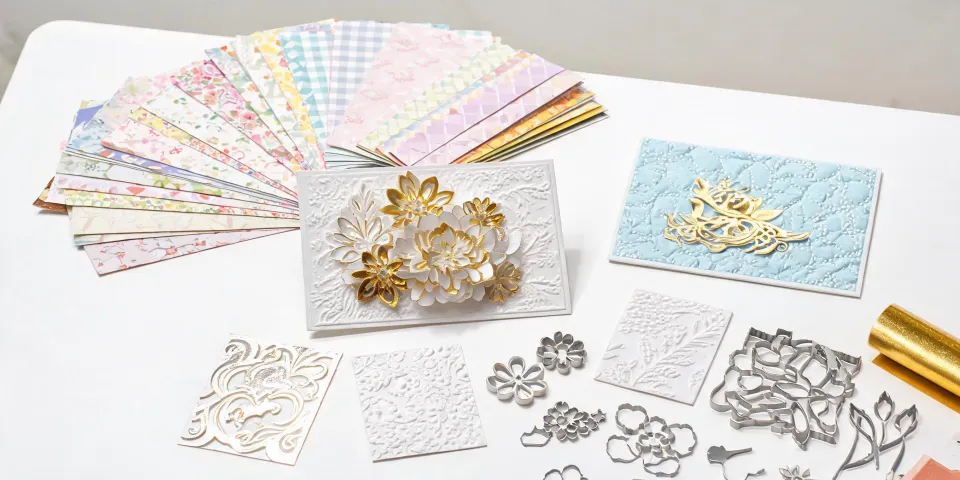
I dug deeper into spellbinders paper crafts and found a whole ecosystem: the machines (Platinum, Grand Calibur, Scout), thousands of dies, and the spellbinders craft stax line, which lets you stack multiple layers of cardstock and cut them all at once. For someone producing greeting cards and holiday figurines in small batches, that's huge.
But I made my second big mistake right there.
I went on a spending spree and bought a bunch of dies without a plan. Some didn't match the sizes I actually needed. Some were designs I loved but couldn't use in production. A few I genuinely have no idea what I was thinking. I spent around $600 that first month on dies that are still sitting in a box.
That's also when I learned the lanyard card lesson, round two. There's no dedicated "lanyard card die" in most sets. But Spellbinders does make rectangle dies with rounded corners that match the standard dimensions—you just have to check the specifications carefully before ordering. The Google answer I found in November was the least of my problems. The real challenge was finding the right die and paper combination to produce them consistently at scale.
Building the system
After the holiday order disaster and my die shopping regret, I sat down and built what I now call our "pre-check list." It's simple, but it works:
- Confirm the exact finished dimensions before choosing a die (including the standard lanyard card size if that's what I'm making).
- Test cut one piece first. Measure it. Then run the full batch.
- Keep a die usage log so I know which dies earn their storage space.
- Match paper weight to the die—some detailed dies don't like thick cardstock.
That checklist has caught 47 potential errors in the past 18 months. I keep count because it keeps me honest.
The shift to spellbinders craft stax changed my production math. A holiday figurine that took 12 minutes of hand cutting now takes about 4 minutes, including die swaps. A batch of 200 greeting cards that used to take a whole weekend now takes an afternoon. The machine runs while I prep the next assembly step.
And there's something deeply satisfying about pulling a perfectly cut stack out of a machine, knowing every piece is identical. After years of hand cutting and eyeballing measurements, that feeling doesn't get old.
What it actually costs
Let's talk numbers. A die cutting machine isn't cheap. The Spellbinders Platinum series ranges around $200–300 depending on the bundle and where you buy it (pricing as of January 2025—definitely verify current prices). Dies run from about $5 to $25 individually, and sets like the craft stax collections are more like $30–60.
I hear people say "that's expensive" when they're used to a $12 pair of scissors. To be fair, the upfront cost is real. But the math changes when you calculate your time. At the volumes I'm producing, hand cutting was costing me roughly two full working days per large order. Two days I couldn't spend on client communication, new designs, or packaging. The machine paid for itself within three orders.
And honestly? If I could go back and give myself one piece of advice, it would be this: start with the machine, buy a few well-chosen dies, and build from there. You don't need the entire catalog on day one. That's a lesson I paid $600 to learn.
The real lesson
The lanyard card mistake wasn't really about not knowing the size. It was about not having a reliable way to produce consistent pieces at volume. The holiday figurine disaster? Same root cause.
To be fair, I get why people stick with hand cutting. If you're making a few items for yourself, the upfront cost of a machine genuinely might not be worth it. There's value in the handmade, and I'm not dismissing that. But if you're selling to customers with deadlines and quality expectations, consistency isn't optional. It's the whole job.
Granted, this requires more upfront work than just buying a machine and hoping. You have to research dies, test materials, and build your own checklists. But it saves you time, materials, and the specific kind of embarrassment that comes from delivering a stack of visibly uneven ID cards to a client who trusted you.
The system isn't perfect. I still make mistakes—just smaller ones now. A wrong paper color here, a slightly rushed assembly there. Nothing that costs $890 and a week of sleep.
Final thought
If you're serious about paper crafts, greeting cards, holiday figurines, or any repeatable paper product, the question isn't whether to get a cutting machine. It's which machine and which dies fit what you're actually making. In my opinion, Spellbinders is worth a hard look—not because it's the only option, but because the ecosystem means you can scale from a single holiday figurine to a corporate order without rebuilding your workflow.
And if you're making lanyard cards? Now you know the size: 3.375 by 2.125 inches. Get a rounded-corner rectangle die in those dimensions, test your paper weight, and run a sample before cutting all 150.
Learn from my mistakes. I've got plenty to go around.