If you've ever had to deliver a fully decorated holiday display by Friday when someone places the order on Tuesday, you know that 'rush' is a four-letter word. In my role coordinating production for craft-focused B2B clients, I've handled more weekend scrambles than I can count. The first thing I learned? There's no single right answer. The best solution depends on how much time you have, how many units you need, and how much customization is involved.
From the outside, it looks like a rush order just means someone needs to work faster. The reality is that speed requires completely different workflows, tools, and sometimes a bigger budget. That's why I break every urgent request into three scenarios. Pick the one that matches yours, and you'll have a clearer path.
Scenario 1: You Need Holiday Figurines or Ornaments by Tomorrow Morning
You're an event planner or a retailer. A client walks in at 4:30 PM needing 200 reusable Christmas ornaments for a corporate gift exchange. The deadline is 9 AM. No time to hand-craft each one. This is where a die cutting machine isn't a luxury — it's the difference between sleeping and not.
With a Spellbinders Platinum die cutting machine (I use the Platinum 6 in my shop), you can die-cut multiple layers of cardstock, glitter paper, and even thin wood sheets in a single pass. If you're working with larger stock, the Grand Calibur has a 9-inch opening, which is a game-changer when you need 8.5" x 11" pieces. Pair your machine with a holiday figurine die set — think snowflakes, icicles, or their Classic Mouse series — and you'll have a consistent batch of decorations in under an hour.
On the surface, ordering pre-made ornaments might seem faster. What buyers miss is that pre-made items rarely match a client's branding or theme. Here's the counterintuitive part: custom die-cutting is actually the faster path because you control the materials and palette. Your only added cost is the machine time and the dies.
In December 2024, I helped a trade show organizer who needed 50 centerpiece snowflakes with a custom logo inlay. We used a Platinum 6 and two nested dies. Total production time: about 90 minutes. They had a hard 6 PM loading dock deadline. It worked. Not glamorous, but done.
Scenario 2: Personalized Physical Gift Cards? They Don't Have to Come from a Third Party
One question that comes up constantly from gift shops and corporate buyers is: who sells personalized physical gift cards? The real answer is: you can make them yourself.
If you only need a few dozen, outsourcing to a print shop is fine. But if you're looking to offer this as a regular product line, or if your client needs 500 branded cards by Friday, outsourcing becomes a bottleneck. That's when a Spellbinders paper crafts setup turns into a revenue stream.
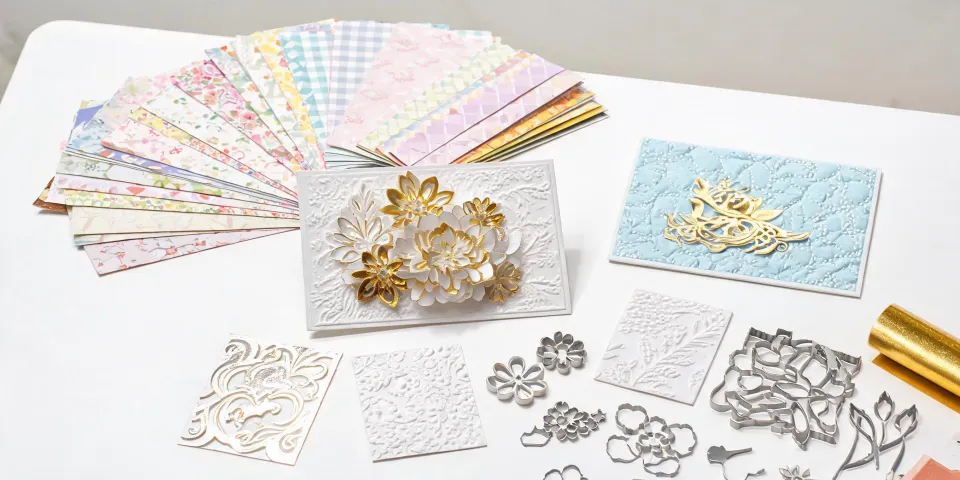
Use a Spellbinders Platinum machine to cut card bases, then layer in die-cut snowflakes, a gift card holder insert, and a subtle embossed border. Print the personalized names and messages on a laser or inkjet printer before final assembly. Set up a simple production line: one person cuts, one folds, one finishes.
Now, about shipping. If you're mailing those cards to clients, don't forget USPS rules. According to USPS Business Mail 101, a standard letter must be between 3.5" x 5" and 6.125" x 11.5", with a thickness of no more than 0.25". Most die-cut cards comfortably fit that, but if you add a 3D element like a foam pad, you might push it into the large envelope category, which costs more. First-Class Mail large envelope postage starts at $1.50 as of January 2025. That's not huge, but it adds up when you're sending 500.
I remember a client who ignored envelope thickness and ended up paying $0.63 extra per piece in unexpected postage. It ate their entire margin. The question everyone asks is how fast can you print? The question they should ask is will it fit in a standard envelope?
Scenario 3: You're a Craft Retailer and Your Supplier Just Failed on a Christmas Line
This one hurts. You placed a PO for 300 holiday figurine kits, and the vendor calls on Monday to say they won't arrive until January. Your shelves are empty. Your customers are asking. This is where a bit of emergency planning pays off.
If you have a Spellbinders die cutting machine on site, you can produce your own kits in-house. Use a set of classic holiday figurine dies, cut from heavy cardstock, and package them in cello bags with instructions. They might not be as elaborate as the imported ceramic ones, but they're in-stock, they're yours, and you control quality.
Before you jump in, set up a verification checklist. We didn't have one at our facility, and it cost us when we misordered a pack of interchangeable platforms. The third time that happened, I created a simple checklist: paper type, die size, machine platform, and pressure rating. That's it.
So, what's the real lesson? In a crisis, don't chase the cheapest replacement. Pay for speed and reliability. One urgent order might cost you $200 extra in materials and overtime, but missing the season entirely costs you thousands in lost sales and reputation. Simple math.
One thing I've learned over the years is that a die cutting machine is only as useful as the dies and accessories you have on hand. Spellbinders' ecosystem is its biggest advantage in an emergency. If you already have a Platinum machine, a stocking of holiday dies, and a few spare cutting plates, you're ready. If you don't, any urgent order becomes a scramble to find compatible tools. That's why I tell retailers to treat the machine like a fire extinguisher: you hope you never need it at 5 PM on a Saturday, but when you do, you're glad it's mounted on the wall.
Which Scenario Are You In? A 3-Question Self-Check
Still not sure how to prioritize? Here's how I triage:
- How many hours before the deadline? If it's under 24, your workflow has to be a production line, not custom craft.
- How many units are we talking? Under 50, you can probably manage with a single die and a manual machine. Over 200, you need nested dies or a larger platform like the Grand Calibur.
- Does it need to be personalized? If yes, plan for extra steps like printing and layering, and don't forget the envelope sizing.
If your situation matches scenario 1, focus on machine speed and dies. Scenario 2? Add a mailing logistics check. Scenario 3? Build your own backup setup now, before the next season hits.
A quick note on the cost question. In emergency situations, the cheapest option is rarely the best. A $30 die from a discount supplier that arrives in 10 days is useless if your deadline is Thursday. A $45 die from a reputable source with overnight shipping is a bargain if it means you can produce on time. The premium you pay is essentially insurance. That's a calculus I apply to every rush order.
Bottom line: in the craft industry, 'rush' doesn't mean 'faster.' It means 'different.' The right Spellbinders products don't just save time — they give you the certainty that you'll meet the deadline. Is the premium worth it? When a missed deadline means losing a contract or leaving shelves empty, the math answers itself. I've paid that price more than once. Now I budget for certainty, not hope.