Corporate gift cards are prepaid cards that businesses give to employees, clients, or partners—usually for holidays, anniversaries, or performance milestones. That's the textbook answer. But after four years as a quality compliance manager, reviewing gift products before they reach customers, I can tell you the textbook answer misses the point.
What you pair with a corporate gift card matters more than the card's value. A gift card alone is a transaction. Add a well-made holiday figurine or a thoughtfully printed greeting card, and it becomes a message about your brand. If you're a business owner, procurement manager, or someone responsible for holiday gifting decisions, this distinction matters more than you think.
I'm a quality compliance manager at a crafts and gifting company. I review every physical gift product before it reaches customers—roughly 200 items per year. I've rejected 12% of first deliveries in 2024 due to finishing defects: uneven die-cut edges, thin cardstock, packaging that folded in transit. Most clients never saw these issues because we caught them in time. But the close calls taught me a lesson—or rather, they confirmed one I'd already learned the hard way in 2022.
That year, a batch of 8,000 holiday figurines arrived with visible color inconsistency. The vendor claimed it was "within industry tolerances." We rejected the whole batch. The redo cost us $22,000—or rather, close to that once change orders piled up—and pushed our launch by two weeks. Now every contract includes a color consistency clause. That experience is why I take gift quality so seriously.
Here's something I've come to believe after all those reviews: a physical gift is the only part of your company the recipient actually touches. Your website, your emails, your invoices—those are transactional. But a gift sits in someone's hands. The weight of the box, the texture of the paper, the precision of the product—those details communicate more than any marketing copy.
What Are Corporate Gift Cards, Really?
Corporate gift cards come in two forms: open-loop cards (Visa, Mastercard, American Express—usable anywhere) and closed-loop cards (store-specific, like a retail chain or restaurant). Companies buy them in bulk for four main reasons:
- Employee recognition and reward programs
- Client appreciation during the holiday season
- Partnership incentives and milestone celebrations
- Loyalty program bonuses and referral rewards
They're popular because they're practical. No inventory to manage. No shipping damage to worry about. Recipients get flexibility. But practical doesn't mean memorable—and for corporate gifting, memorable is the goal. With so many brands sending gift cards during the holidays, yours is competing for attention with dozens of others on every manager's desk.
What I Learned From Comparing Two Gifting Approaches
In Q3 2024, we worked with a client who ran a side-by-side test (well, their marketing team ran it; we just audited the products). Two teams each sent holiday gifts to their top 50 customers. One team sent a $100 corporate gift card in a standard envelope. The other sent the same $100 card, but paired with a premium holiday figurine and a handwritten greeting card.
Recipient feedback, collected about 30 days later, was starkly different. The second team's customers described the gift as "thoughtful" or "personal" at more than double the rate of the first team's. Nobody from the first group mentioned the gift unprompted. Now, that's one data point, not a scientific study. But it matches what I've seen in supplier audits across the industry: tangible quality changes how recipients interpret a gift.
Most buyers focus on the dollar value of the card and completely miss the physical presentation. The question everyone asks is "what's the card amount?" The question they should ask is "what does the recipient see when they open the box?" That's the blind spot most corporate gifting programs have.
Why the Tools Behind Your Gifts Matter
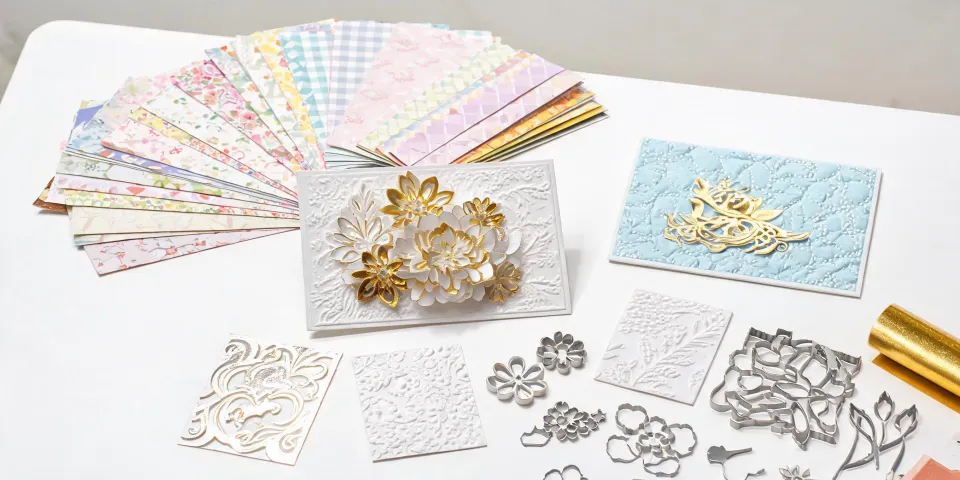
If your business creates its own greeting cards, craft kits, or decorative items for corporate gifting, production quality is your brand. That's why die cutting machines like the Spellbinders Platinum 6 die cutting machine are worth the attention they get. The Platinum 6 delivers consistent, precise cuts across cardstock, foil, and thin metal—which means your greeting cards and paper crafts look uniform, not homemade. It's a popular choice for small businesses and craft studios because it handles both delicate paper and thicker materials, giving you room to experiment without losing reliability.
For context, die cutting means using a metal die to cut shapes out of material. The Platinum 6 is a six-inch platform system that uses pressure rather than electronics, which keeps it dependable and easy to operate. For a business producing 200 holiday greeting cards, that dependability can be the difference between a batch that looks professional and one that looks like a weekend experiment.
Consistency might sound boring. But in quality control, uniformity is the whole game. I've audited handcrafted gift items where every piece was slightly different. Sometimes that's charming—for artisan markets. For corporate gifting at scale, uniformity signals quality. A machine that produces identical results every time protects your brand's reputation. That's quality insurance, not over-engineering.
Ready-Made Options: The Spellbinders City Holiday Collection
Not every company wants to produce its own gifts, and that's fair. Curated collections exist for a reason: they take the quality gamble out of corporate gifting. Spellbinders' City Holiday collection is a good example. It includes holiday figurines and seasonal decorations with a polished, cohesive aesthetic—designed for gifting, not as an afterthought. The collection covers miniature city landmarks, festive buildings, and seasonal characters, all in a consistent design language. That consistency matters for quality perception: a unified look across different items makes your brand seem intentional.
A holiday figurine from a premium collection, paired with a greeting card, does what a gift card alone can't. It sits on the recipient's desk or mantle. Every time they glance at it, they think of your company. A gift card, by contrast, is spent and discarded within weeks. If you're ordering in bulk for the holiday season, it's worth asking about quantities and lead times before the rush starts. (Which, honestly, I should have done more carefully myself a while back.)
When a Plain Corporate Gift Card Is the Right Call
Let me add some honesty here, because quality doesn't mean "premium everything, always." There are situations where a plain corporate gift card is genuinely the right choice:
- Low-value rewards: Under $25, the card is the gift. Adding a physical item feels like over-packaging.
- High-volume programs: If you're distributing 5,000+ cards, the logistics of pairing each with a physical item can outweigh the branding benefit.
- Internal recognition: These programs prioritize speed and frequency. A $20 coffee card handed out quickly beats a slow, elaborate presentation.
And let's be honest about budget. A $25 gift card with a well-designed greeting card and careful packaging makes a better impression than a $100 card thrown into a generic envelope. Effort reads as quality. You don't need the most expensive option; you need the consistent one. If a tangible item truly isn't feasible, consider upgrading the delivery. A sturdy gift box or a hand-signed note closes some of the gap—it won't have the staying power of a holiday figurine, but it shows effort.
A Final Caution From Someone Who's Been Burned
I'll close with a mistake I made. In late 2024, with the holiday cutoff looming, we had three days to approve a 500-unit gift order. Normally I'd run a full packaging spec review. There was no time. I trusted a supplier's "premium" line based on past performance alone. The batch arrived with packaging that was too thin for the figurines, and several pieces showed edge damage. We spent the next week reworking the order. In hindsight, I should have pushed back on the timeline or at least requested samples. But with the CEO waiting, I made the call with incomplete information.
The lesson stuck with me: quality isn't about always choosing the premium option. It's about verifying the specifics, checking the details, and making sure what you send represents your brand correctly. The definition of what are corporate gift cards is simple. The discipline of making them reflect your brand is where the real work lives.