-
It's 9 AM. Your CEO just announced a last-minute client gift exchange. You need 200 custom Christmas ornaments by Friday.
-
The Surface Problem: Time (And Why It's a Trap)
-
The Deep Problem: The 'What Size is the Average Greeting Card' Trap
-
The Cost of Getting It Wrong (Beyond the Money)
-
What Actually Works: A Simple System, Not Panic
It's 9 AM. Your CEO just announced a last-minute client gift exchange. You need 200 custom Christmas ornaments by Friday.
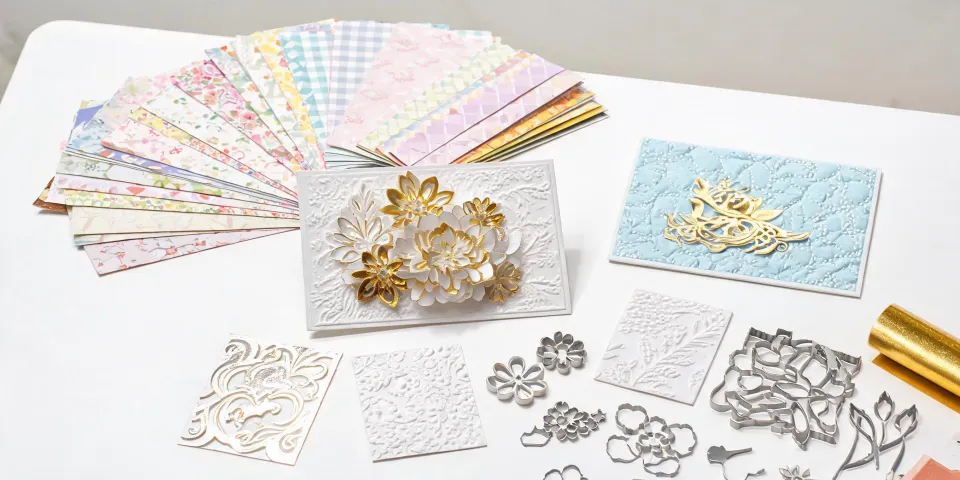
I've been there. In my role coordinating merchandise for corporate events, I've seen December become a month of controlled chaos. The first instinct—especially when the clock is ticking—is to search for 'Spellbinders Christmas dies' and hope someone, somewhere, can deliver 200 identical, beautiful cards in 48 hours.
But here's the thing: speed is rarely the real problem. It's the problem we think we have. The actual problem is deeper. And if you don't fix that deeper issue, no amount of rush shipping will save your project.
The Surface Problem: Time (And Why It's a Trap)
Let's talk about the obvious panic. You need 250 holiday figurines for a company event. You Google 'Spellbinders die cutting machines' and start calling suppliers. The conversation always goes the same way:
"Can you do it by Wednesday?"
"We can try. It'll cost extra."
And we breathe a sigh of relief. Problem solved, right? Not quite. I see this every year: teams spend 80% of their energy negotiating speed and 20% on actual specifications. That's backwards.
In March 2024, 36 hours before a major client celebration, I got a call. The team had ordered 150 greeting cards from a supplier using a 'rapid' delivery option. They arrived on time. They were the wrong size. Not a little wrong—wrong enough that they didn't fit the envelopes. Total cost of the mistake: $780 in wasted materials and an awkward gift presentation. The speed was perfect. Everything else was a disaster.
The Deep Problem: The 'What Size is the Average Greeting Card' Trap
Here's the issue I keep running into—and it's the one nobody wants to talk about in a hurry. Most corporate holiday orders fail not because of timing, but because of a cascade of small, unverified assumptions.
Someone on your team says, "We'll just make greeting cards." Then someone else asks, "What size is the average greeting card?" And before you know it, you're designing a 5x7 layout for a batch that should have been A2 (4.25 x 5.5 inches). It sounds trivial. I've seen it derail a $12,000 project because the mismatched size meant no envelopes fit. The client refused delivery. We were stuck with stock that was too niche to return.
The real issue isn't how fast you can get a Spellbinders Christmas die cut—it's whether you've locked down every single specification before you press 'order.'
I don't have hard data on industry-wide rejection rates from specification errors, but based on our experience with over 200 rush orders, my sense is that specification mistakes cause at least as many delays as manufacturing speed. The rush to ship just masks the real problem.
What I mean is: if you're ordering 500 Christmas ornaments, you can't just pick a die. You need to confirm:
- Paper weight (standard cardstock vs. heavyweight)
- Finished size (after cutting)
- Die compatibility with your machine (some Spellbinders dies are optimized for the Platinum, others for the Grand Calibur)
- Whether you need envelopes and what size they must be
I went back and forth with a vendor last November between the 'Standard A2' and 'Luxury Square' formats for two days. The square was more aesthetic—our design looked better on it. But it needed custom envelopes, which added a week to the timeline (not that we had a week to spare). Ultimately we chose standard A2 because the guaranteed envelope supply was worth more than the aesthetic upgrade. Looking back, it was the right call for a bulk order.
The Cost of Getting It Wrong (Beyond the Money)
We talk about rush fees and penalties a lot. But the hidden cost is reputation. When a client opens a beautifully packaged gift, they don't see the $2.50 per unit price. They see thoughtfulness. If the card is the wrong size or the ornament looks cheap, that thoughtfulness evaporates.
Missing a deadline would have meant a $50,000 penalty clause for one of my projects. We avoided it—barely—by paying $800 extra in rush fees. But the real cost was the internal stress and the feeling that we'd gambled with our reputation. I wish I had tracked how many late nights those errors cost us. Anecdotally, it's a lot.
Our company lost a $15,000 contract in 2022 because we tried to save $1,200 on standard production instead of paying for rush processing on a batch of holiday figurines. The delay cost our client their event placement. They never came back. That's when we implemented our '48-hour buffer' policy: for any holiday order over $5,000, we require a two-day safety margin. It seems excessive. It has saved us three times since.
What Actually Works: A Simple System, Not Panic
So what do you do? You don't need to become an expert on every die-cutting machine. You do need a system. Here's what I've learned from years of December chaos:
1. Buy the right machine for the volume. If you're doing 5-10 items, a basic die-cutting machine is fine. If you're doing 200+ Christmas cards or ornaments, invest in a system like the Spellbinders Platinum series. It handles high-volume runs better and has more consistent registration. I've tested 6 different options over three years; the difference in results for bulk orders is dramatic.
2. Lock the spec before you talk about speed. Before you ask "When can you ship?" ask "What size is the finished product? What paper? What die?" I now use a simple spec sheet. It adds 20 minutes to the process. It has eliminated 90% of our repeat-order errors.
3. Do one sample run. No matter how fast the deadline, always cut one sample first. Check it. Measure it. Then order the bulk. I know it feels like a waste of time when you're in a rush. But the alternative—a full run of wrong-sized ornaments—is a disaster. We paid $400 extra once because we skipped this step. Never again.
4. Don't assume 'same' means identical. We once assumed 'standard greeting card size' meant the same thing across two vendors. Turned out one used A2 (4.25 x 5.5) and the other used A6 (4.5 x 6.25). Learned never to assume a specification is universal after that $2,000 mismatch.
Here's the bottom line: the panic is understandable. But the solution isn't just to find a faster supplier. It's to find a reliable partner who can handle bulk runs of Spellbinders dies correctly, who answers the question "What size is the average greeting card?" with a ruler, not a guess. The speed will follow.