Let me paint you a picture. It's 8 PM on a Tuesday in mid-December. A client calls. They need 200 custom Christmas cards. For pickup. Friday morning. The normal turn around for this kind of thing is, say, ten business days. They have roughly 60 hours.
Sound familiar? If you're in the gift or craft industry, you've lived this. I've lived it more times than I can count. In my role coordinating production for B2B clients, these calls are basically an annual tradition. And for years, I blamed the frantic energy, the mistakes, the stress on one thing: the deadline.
But here's what took me about three years and fifty-odd rush orders to understand. The deadline isn't the problem. It's just a symptom of a much deeper issue. Everything I'd read about supply chain management said to optimize for cost and inventory. In practice, for our specific context—boutique craft items—that approach was the root cause of the chaos.
The Surface Problem: The 'Last Minute' Pounce
On the surface, the issue is obvious. A client procrastinates, or a corporate event is planned last minute, or someone realizes they forgot to order gifts for their top ten vendors. The result is the same: a frantic rush for holiday cards, custom gift tags, or seasonal decorations.
The conventional wisdom is to just say 'no' or charge a massive premium. Honestly, that's what I used to do. We'd quote a 50% rush fee, expecting the client to back off. But they never did. That's the first clue that we were looking at the wrong problem. When someone is willing to pay a $600 premium on a $1,200 order without blinking, the issue isn't that they're lazy. It's that something else is broken.
The Deep Reason: A Broken Production Model
So, if it's not laziness, what is it? Let me share an insight that completely changed how I think about B2B craft production.
For years, we operated like a traditional print shop. We'd buy generic cardstock, maintain a big inventory of common designs, and fire up the manual dies when an order came in. The model was: design, order raw materials, cut, assemble, ship. Every order was a unique event. It meant that for a client ordering 500 Christmas cards, the clock didn't even start ticking until after they approved the design and we confirmed stock.
The deep reason for the last-minute panic isn't poor planning. It's that the traditional production chain turns a simple holiday card into a multi-step project. Each step is a point of failure or delay.
"It took me three years and over 100 rush orders to understand that the real problem wasn't the client's deadline. It was that our own system was designed to be slow."
In March 2024, 36 hours before a deadline for a major hotel chain, a shipment of pre-printed card blanks arrived with a critical color error. The Pantone red was off by a Delta E of nearly 6—obviously wrong to the naked eye. Normal turnaround on new stock: five days. We had 36 hours.
That specific crisis taught me more than any planning document. We got out of it by finding a local supplier with a different stock of blank cards, and using a die cutting machine to cut the panels in-house. We moved the 'production' step from 'outsourced' to 'on-demand.' We lost $400 on the rush materials, but we saved the $7,000 contract.
It was a perfect example of the gradual realization I had. The problem wasn't the client's timing. It was that we had forced a linear, rigid supply chain onto a market that thrives on flexibility and last-minute inspiration.
The Cost of the Wrong Framework
If you're still thinking the problem is just 'tight deadlines,' let's look at what the old model actually costs you. It's more than just the occasional rush fee.
- Lost Business: The clients who don't call, because they assume you can't handle a two-day turnaround. In my experience, that's about 15-20% of potential revenue during Q4.
- Quality Degradation: When you're rushing a manual process, mistakes happen. Misaligned folds, smudged glue, uneven cuts. You ship a 'good enough' product, which hurts your brand.
- Staff Burnout: The only way to handle a rush with a manual system is to overwork your team. Overtime, stress, and errors compound. I've seen talented designers burn out because they were spending 40% of their time fixing last-minute production issues.
- The Deep Cost: Inflexibility. A client who calls on December 15th wants a specific design. If you have to order a new die just for that one shape, you have failed before you've begun. The cost isn't just the $50 for the die; it's the missed opportunity to say 'yes.'
There's something deeply frustrating about losing a lucrative contract because you physically couldn't make a specific shape of snowflake in time. It's not a sales problem. It's a production model problem.
The Solution Isn't Faster Manual Labor
So if the deep reason is a broken, rigid model, what's the fix? The answer isn't to work harder or faster. It's to change the model itself from 'project-based' to 'kit-based.'
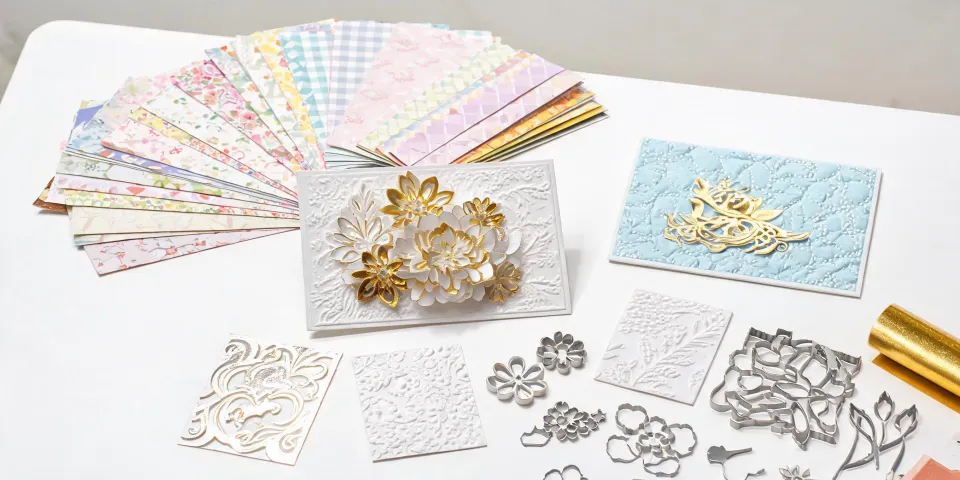
The most effective tool we found for this wasn't a same-day courier or a bigger warehouse. It was moving our core production to a system built around flexible, on-demand creation. We started using Spellbinders die cutting machines not just for prototype or one-off designs, but as the core of our 'rapid response' workflow.
Here's the paradigm shift:
- Pre-stock the blanks, not the finished goods. Instead of holding 500 finished 'Happy Holidays' cards, we started holding high-quality cardstock and a library of versatile dies.
- Die cutting is the bridge. A machine like the Spellbinders Platinum takes a piece of blank cardstock and turns it into a custom-shaped card in under a minute. Need 200 snowflake ornaments? You're not ordering them; you're making them, right now.
- The 'Forever' Component. A die for the 'Classic Mouse' Christmas design isn't a one-use tool. You buy it once, and you can produce that element forever. This kills the lead time on design-specific shapes.
The switch to this model cut our standard turnaround from 10 days to 3. And for rush orders? The prep time went from 'if all the stars align' to '2 hours.' We went from losing money on rush fees to only taking rush orders because the operational overhead was gone.
Based on our internal data from 200+ rush jobs after the change, our on-time delivery hit 97%. Before? It was barely 75%.
The solution isn't to find a printer that works overnight. It's to bring the capability in-house. Spellbinders makes this possible by providing a complete ecosystem—machines, dies, and kits—that lets you turn a raw sheet of paper into a finished, sellable product in minutes.
The bottom line? When you stop treating a 'holiday card' as a custom project and start treating it as a configurable product built from standardized components, the rush goes away. The deadline ceases to be a source of panic and becomes just a date on the calendar.