If you've searched "what is the best fabric cutting machine," you've probably seen two kinds of answers: bloggers who tested one machine and anoint it the winner, and forum threads that end in arguments. I get it. In my role as a production coordinator for craft suppliers and gift shops, I've handled over 200 rush orders in the last six years—including same-day turnarounds for clients who needed holiday figurines, greeting cards, and custom packaging before a trade show. So I'll say this plainly: there is no universal best. The right machine depends on what you cut most, in what volume, and under what deadlines.
Let's break it down by three scenarios.
First, understand the difference between paper die cutting and fabric cutting
When people search "what is the best fabric cutting machine," they're often thinking of a machine built to handle textiles—one with rotary blades, pattern scanning, and mats designed for stretchy material. Die cutting machines like the Spellbinders Platinum 6 die cutting machine are a different category. They use steel-rule and wafer-thin dies to cut paper, cardstock, vellum, cork, leather, and other non-textile materials. Some can handle lightweight fabric with the right accessories, but that's not their main strength.
So the real question isn't "which machine is best?" It's "what does your production day actually look like?"
Scenario A: You mainly make greeting cards, ornaments, and holiday figurines
If your product line is mostly paper crafts—handmade greeting cards, holiday figurines, gift tags, packaging—you might be shopping in the wrong category. You don't necessarily need a fabric cutting machine. You need a reliable die cutting system for paper and cardstock.
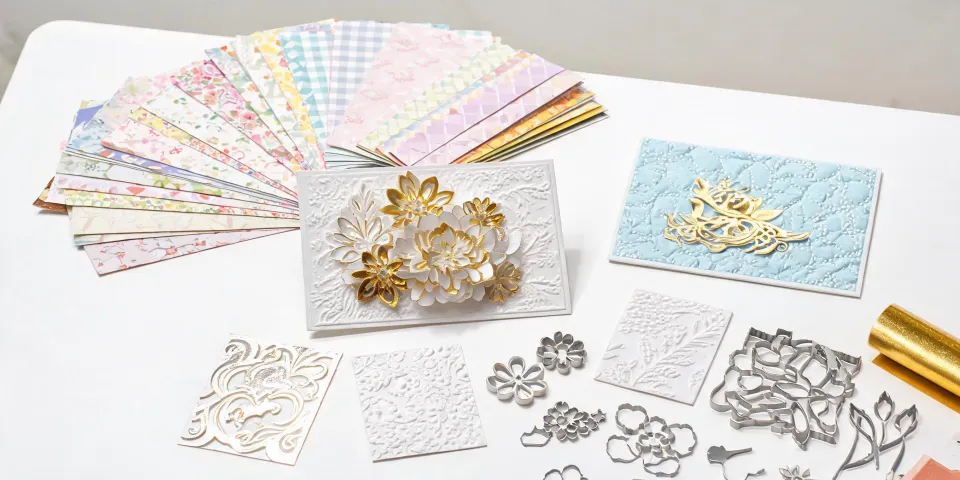
This is where I'd point you toward Spellbinders. I'm not saying that because of the Spellbinders logo on the box. The logo represents a whole ecosystem: machines, dies, and accessories designed to work together. The Spellbinders Platinum 6 die cutting machine has been a workhorse in our shop for exactly this type of work. It cuts intricate wafer-thin dies cleanly, which matters when a greeting card's floral border has to look crisp to a client. Spellbinders' seasonal collections like City Holiday and Classic Mouse are built around the same system, so if you're producing holiday figurines in volume, you can scale without switching platforms.
Let me give you a real scenario. In March 2024, a wedding stationery client called at 9 a.m. needing 200 die-cut welcome signs for a Saturday event. Normal turnaround for custom paper goods like that is about a week. We paid the express shipping charge on the cardstock, spent the evening running the whole stack through a Platinum 6, and delivered on Friday at noon. The client's alternative was blank signs—which would have looked unfinished next to the wedding florals. Missing that deadline wasn't a financial penalty; it would have burned a long-term relationship.
That's the quality perception issue. When someone opens a greeting card or displays a holiday figurine, the first thing they register is the edge quality. Rough cuts and dented corners read as "cheap." Clean cuts read as "professional." In my opinion, that's worth more than any feature list. And if you're shipping those handmade greeting cards, the numbers matter too. According to USPS (usps.com), as of January 2025, a First-Class Mail letter is $0.73 and a large envelope is $1.50. A cutter that produces consistent, standard-sized cards helps you avoid oversized or warped envelopes that cost more to mail.
Scenario B: You actually cut fabric, in volume
To be fair, if you're a B2B buyer sourcing custom sewn products—garment samples, textile ornaments, placemats—you probably do need a dedicated fabric cutting machine. A paper-focused die cutter can cut felt or simple appliqués, but it's not ideal for bias-cut cotton or slippery knits.
Your search for "what is the best fabric cutting machine" should focus on rotary blade precision, pattern registration, and mat compatibility. In my experience, those machines are bigger, pricier, and more finicky. The specs often look great on paper; the real test is how they handle a stack of five-yard bolts.
Honestly, I'm not sure why some fabric cutters with impressive marketing materials underperform on basic textiles. My best guess is that they optimize for features you can list on a box, not for the mess and friction of real production. Here's a moment when I ignored my gut. The numbers said a combo machine—one that could handle fabric and paper—would save us money. Reviews were decent. My gut said the shop down the road had a miserable time with theirs. The spreadsheet won. Within three weeks, the combo machine mangled a stretch knit order for a boutique hotel. We ended up borrowing a friend's fabric cutter and pulled a $15,000 order through in two days. That experience changed our equipment policy: dedicated machines for dedicated materials.
So if fabric is at least half your output, look for a fabric-specific cutter. Don't let a versatile paper machine be your only workhorse.
Scenario C: You run a mixed craft business
Maybe you make holiday figurines in October, greeting cards in December, felt garlands in spring, and the occasional fabric tote for a pop-up event. That's the mixed scenario.
If you ask me, a mixed craft business doesn't need two machines right away—unless fabric is a major revenue driver. Start with a solid die cutting system for your paper products, learn your dies, and outsource or hand-cut the occasional fabric piece. Once fabric orders become predictable, add a dedicated fabric cutter. Granted, this requires honesty about your material mix. But it saves a ton of money and bench space.
How to know which scenario you're in
Instead of reading another generic list, audit your last 20 projects:
- What materials actually appeared?
- How many projects were paper-based?
- How many involved fabric, and was fabric the main product or just an accent?
- How often did you miss a deadline because the machine couldn't handle the material?
If 80% of your projects were greeting cards, holiday figurines, tags, and packaging, then the best answer to "what is the best fabric cutting machine" might be a question in return: do you need a fabric cutting machine at all? You probably need a better die cutter for paper. That's where the Spellbinders Platinum 6 die cutting machine earns its place in a busy studio.
Per FTC guidelines (ftc.gov), I can't promise one machine is objectively "best" without evidence. I can tell you what I've seen across 200+ rush orders: for paper-based products, a consistent die cutting system with clean dies and a sturdy platform wins. For fabric products, you want a machine designed for fabric. Everything else is sales copy.
Bottom line: the best fabric cutting machine is the one that matches your material mix, your volume, and your quality bar. Give me a machine that produces clean cuts and holds up under a deadline, and I'll pick it over a more feature-heavy model every time. The brand won't matter as much as how your work makes clients feel about your brand.